There is a quiet frustration spreading through SEO teams everywhere right now. You check rankings in the morning, see position three for a keyword you fought hard to win and feel good about it. Then you open Google Search Console and the click data makes no sense. Impressions up. Clicks flat. Traffic sliding. Nothing broken. Just invisible.
That is not a glitch. That is the new reality of SERP visibility and it is reshaping how smart marketers need to think about search.
What SERP Visibility Actually Means?
Most articles will tell you SERP visibility is simply how prominently your website appears on search engine results pages. That is technically correct and also nearly useless as a working definition.
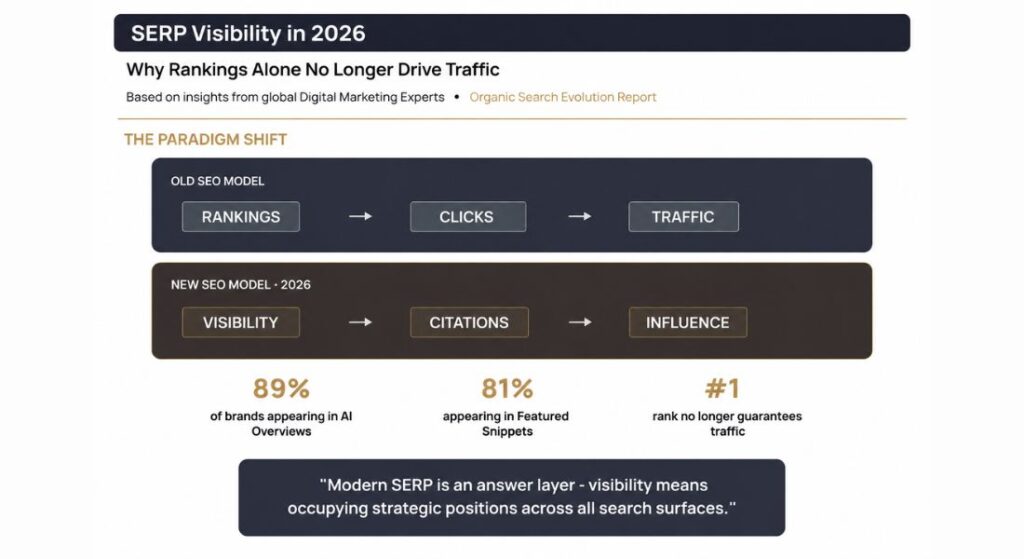
The more honest way to understand it is this: SERP visibility measures the gap between being ranked and being seen. Those two things used to be almost the same. In 2026 they have quietly become very different.
Think about what a results page actually looks like for a competitive query today. Before a user even reaches your organic listing they scroll past an AI Overview, a featured snippet, a People Also Ask box with four expandable questions, a video carousel, two paid ads and sometimes a local map pack.
Your position three result is physically sitting below all of that. On a laptop screen a user might not even see it without scrolling. On a phone they almost certainly will not.
This is what search engine visibility really means in practice. It is not just where you rank. It is whether someone can actually find you on the page and whether once they do your listing gives them a reason to click.
The Anatomy of a Modern SERP (and Why It Matters)
Understanding the structure of a search results page is not optional anymore. It is a foundational strategy.
The modern SERP has several distinct zones and each one competes for the same finite screen space and user attention.
Paid placements appear at the top and bottom labeled “Sponsored.” They are determined by bid strategy Quality Score and ad relevance. A well-funded competitor running Google Ads can occupy the entire visible portion of the screen before any organic result appears.
AI Overviews are Google’s AI-generated summaries that aggregate answers from multiple sources. They appear for roughly 8 to 13 percent of all queries as of recent data but that percentage is rising steadily. For informational and how-to searches AI Overviews are becoming the default first answer. Critically, users who get their answer from an AI Overview often never click anything at all. This is the core of the zero-click problem.
Featured snippets are brief direct answers pulled from a single web page and placed above the standard organic results. They appear in paragraph form list form or table form depending on the query. Winning a featured snippet is genuinely valuable but only if you understand which queries still drive clicks even after the snippet shows.
Knowledge panels appear on the right side of the desktop SERP for well-known entities, businesses, people and organizations. They pull data from Google’s Knowledge Graph Wikipedia and structured data on your own website. Having a populated knowledge panel is a signal of brand authority and entity recognition.
People Also Ask (PAA) boxes now appear in over 67 percent of all searches according to Semrush Sensor data. Each PAA box contains related questions that expand when clicked showing a short answer and a source link. These boxes can appear multiple times throughout a results page effectively pushing organic listings further down with every interaction.
Local packs contain a map plus three business listings for location-based queries. For a plumber, a dentist , a restaurant or any service business the local pack is often more commercially important than any other SERP feature. If you are not in the top three of the local pack for your category and city a large portion of potential customers will never see you.
Video carousels aggregate results primarily from YouTube but increasingly from TikTok and other video platforms. They appear for how-to queries entertainment topics and product-related searches with strong visual intent. If you are creating video content and not optimizing it for search you are leaving a significant visibility surface completely untouched.
Discussions and forum results are a newer feature pulling from Reddit, Quora and niche forums. Google added these partly in response to user behavior: people started appending “reddit” to their searches because they trusted real user opinions more than polished brand content. Now that human experience-based content is baked into the SERP itself.
Image packs appear horizontally across the page for visually driven queries. Design ideas product comparisons recipe photography travel destinations before-and-after service work all of these can and should be optimized for image search visibility.
SERP Visibility as a Metric: How It Gets Calculated?
Here is something most blog posts skip over entirely and it matters more than people realize.
SERP visibility as a trackable metric is not just about whether you appear in results. It is a weighted calculation that factors in both your ranking position and the estimated click-through rate for that position.
The logic works like this. A keyword with 10000 monthly searches that you rank third for is worth a specific estimated traffic volume based on the known CTR curve for position three. But if you move from position three to position one your visibility score jumps dramatically because position one captures roughly 20 to 30 percent of clicks while position three captures significantly less.
A drop from first to third position for a high-volume keyword has a massive impact on your visibility score. A drop from position 47 to position 53 for a low-volume term barely moves the needle at all.
This weighted approach is far more useful than simply counting how many keywords you rank for. Tools like Marketing Miner, Semrush Position Tracking and Ahrefs Rank Tracker all calculate some version of this metric. The formula they use generally multiplies search volume by the estimated CTR of your current position to arrive at an expected monthly traffic figure. Sum all of that across your tracked keywords and you have your overall SERP visibility score.
What makes this metric genuinely useful is that it reflects rank shifts based on their actual potential impact, not just their raw number. A single ranking move for a high-volume high-intent keyword can swing your visibility score dramatically in either direction. That is the kind of information that should be driving SEO prioritization decisions.
The Zero-Click Problem: When Visibility Stops Generating Traffic!
This deserves its own honest conversation because the industry tends to dance around it.
Research from SparkToro found that in 2024 only around 37 percent of US Google searches resulted in a click to an open web page. The rest either ended with no click or the click stayed within Google properties. Nearly 60 percent of searches concluded without anyone visiting a website.
Let that sit for a moment.
If you are measuring your SEO success purely through website traffic you are looking at less than half the picture of what is actually happening on the SERP. People are seeing your brand name, reading your content fragments in featured snippets, absorbing your answers in AI Overviews and forming opinions about your business without ever setting foot on your website.
This creates what has been aptly called the awareness gap. Your brand is present. Your influence is real. But none of it shows up in session pageviews or bounce rate.
The implication for strategy is significant. A zero-click impression is not worthless. Being cited in an AI Overview appearing in a featured snippet or showing up in PAA answers builds brand familiarity and topical authority even when no click follows. The brands that understand this will invest in visibility as an outcome in itself not just as a stepping stone to traffic.
For practical measurement this means tracking branded search volume alongside organic traffic. If people are searching your brand name directly, that is downstream evidence your visibility strategy is working. Branded search growth is one of the clearest leading indicators that your presence in AI summaries and SERP features is generating real-world recall.
Why Rankings and Visibility Are Not the Same Thing Anymore?
Here is the core insight this entire article is building toward.
Imagine two completely different scenarios: same keyword same position three ranking.
In scenario A the SERP is relatively clean. One or two ads have a few organic results and minimal features. Your listing appears near the top of what a user sees. CTR is solid. Traffic flows.
In scenario B your position three listing sits below an AI Overview a featured snippet from a competitor three PAA boxes a video carousel and two ads. On mobile a user would need to scroll past roughly four screen lengths before encountering your listing. Your rank is identical in both scenarios. Your visibility is completely different.
This distinction is the reason experienced SEO professionals have started talking about “SERP real estate” as a portfolio concept rather than a single ranking. Owning one organic position is like owning one apartment in a building.
Owning the featured snippet a PAA answer a video result and an organic listing is like owning the lobby, the rooftop and two floors. Your competitors have to compete for access to the same audience that is already encountering your brand repeatedly on the same page.
This is not a theoretical advantage. Multiple appearances on a single SERP page create a halo effect where users perceive your brand as both authoritative and inescapable. That perception translates into higher CTR for all your listings, stronger brand recall and increased conversion rates downstream.
How to Actually Improve SERP Visibility: Specific Actionable Strategies!
Rather than repeat the standard SEO advice you have read a hundred times the focus here is on the specific moves that directly expand your SERP footprint.
Optimize for featured snippets by answering questions structurally. To win a featured snippet you need to identify queries where a snippet already exists then create a response that is cleaner, more direct and better formatted than the current holder. Use a clear question as a heading immediately with a direct answer in two to three sentences then expand with supporting detail. Do not bury the answer. The snippet algorithm rewards pages that answer first and explain second not the other way around.
Target People Also Ask intentionally. PAA boxes are often treated as a byproduct rather than a target. But they represent genuine secondary intent signals. When you identify what questions appear in the PAA cluster around your main keyword you can create content sections that answer each of those questions explicitly. This increases your chances of appearing inside PAA boxes and it also signals topical completeness to Google which tends to reward content that covers a subject from multiple angles.
Use structured data markup to enable rich results. Schema markup tells search engines what your content is about in machine-readable language. It is the technical foundation for review stars FAQ accordions how-to steps event listings product details and recipe cards appearing directly on the SERP. A business without schema markup is leaving rich result opportunities on the table for competitors who do implement it.
Build and claim your Google Business Profile for local visibility. For any business with a physical location or a defined service area the local pack is arguably more valuable than any organic position. A fully optimized Google Business Profile with accurate categories, complete service listings, regularly updated photos and a consistent stream of genuine customer reviews dramatically increases your chances of appearing in the local three-pack. Location-based visibility is often where the highest-purchase-intent searches happen.
Create content designed for AI citation. Generative Engine Optimization sometimes called GEO is emerging as a discipline alongside traditional SEO. The content that gets cited in AI Overviews tends to be direct, well-structured, factually clear and contextually rich. Long-winded introductions, vague writing and unclear structure actively reduce your chances of being pulled into AI-generated answers. Writing as if you are providing the clearest possible answer to a specific question is the single most practical GEO tactic available right now.
Optimize title tags and meta descriptions as conversion assets. This is criminally undervalued. Your title tag is not just a ranking signal; it is the headline of your ad. In a crowded SERP with AI summaries and rich features above your listing your title and meta description are the only two things standing between a user glancing at your result and actually clicking it. The difference between a generic title and a compelling one can be a 20 to 40 percent difference in CTR with zero change in rankings. That is free traffic that most sites are leaving on the table.
Invest in video content for multi-surface visibility. YouTube is the second largest search engine in the world. Videos optimized with keyword-rich titles, detailed descriptions and accurate transcripts can appear in both YouTube search results and Google video carousels simultaneously. A single well-produced video on a core topic can generate visibility on multiple surfaces with ongoing compounding returns.
Track image search as a visibility channel. For industries with strong visual components such as interior design food fitness fashion home services and real estate image search drives meaningful discovery traffic. Descriptive file names alt text that matches user search language and structured data for image content can expand your visible footprint considerably.
SERP Visibility for Service Businesses: The Local Dimension!
Service businesses operate in a very different visibility environment than e-commerce or media websites. For local businesses like plumbers, dentists , roofers or cleaning companies local SERP features matter more than traditional rankings alone.
The local pack Google Business Profile optimization customer reviews NAP consistency and city-specific landing pages all influence whether a business appears when nearby customers search for services.
Location-based landing pages are especially valuable because they target high-intent searches such as “Water Damage Restoration in Denver” or “Pressure Washing Services in Nashville.” Users searching with city modifiers are often much closer to making a purchase decision.
Citation consistency also matters. Your business name address and phone number should remain identical across Google Business Profile, Yelp, Angi and industry directories because inconsistent information can weaken local visibility signals.
The Multi-Surface Visibility Reality: Beyond Google Blue Links
One of the biggest shifts in modern search is that users no longer rely only on Google to discover brands. Many people now start their research on TikTok, Reddit, ChatGPT or Perplexity before they ever perform a traditional Google search.
That does not reduce the importance of SEO. It expands the meaning of visibility. Brands that consistently appear across AI-generated answers, social platforms, forums and search results build stronger recognition and trust than brands relying only on organic rankings.
How to Measure SERP Visibility Properly?
Most businesses focus on rankings or traffic alone then wonder why their SEO results feel inconsistent. Keyword rankings only show where you appear. Traffic only shows visits. Neither fully explains how visible your brand actually is across the SERP.
A stronger visibility framework combines keyword tracking Google Search Console impressions CTR benchmarks branded search growth local pack visibility and SERP feature ownership. Together these metrics provide a more accurate picture of how often users encounter your brand during search journeys
Entity Building: The Long-Term Visibility Advantage!
Search engines and AI systems increasingly rely on entities instead of isolated web pages. An entity can be a business person product or topic that search engines consistently recognize and understand.
When Google identifies your brand as a trusted entity visibility improves across multiple surfaces. Knowledge panels become more likely branded CTR improves and your content has a better chance of being referenced inside AI Overviews.
Building entity recognition requires consistency across your website structured data Google Business Profile third-party mentions and published content. The more consistently your brand is connected to a topic or expertise area the stronger your long-term search visibility becomes.
Common SERP Visibility Mistakes That Are Easy to Fix
Many visibility problems come from simple SEO mistakes rather than major technical failures.
Generic title tags and weak meta descriptions reduce CTR even when rankings are strong. Missing schema markup prevents your pages from earning rich SERP features like review stars, FAQs and enhanced search listings.
Local businesses also frequently ignore citation management and review optimization both of which strongly influence local pack visibility.
Another major issue is mismatching search intent. A page targeting the wrong intent may rank temporarily but often declines because users are not finding the information they expected.
The Bigger Picture: Visibility as a Business Asset!
SERP visibility is more than an SEO metric. It is a long-term business asset.
High visibility means users repeatedly encounter your brand while researching problems comparing solutions and evaluating competitors. That familiarity creates trust before a user ever visits your website.
Businesses that expand visibility across organic results AI Overviews local packs videos and user-generated platforms build stronger long-term competitive advantages than brands focused only on rankings alone.
Conclusion:
Understanding SERP visibility is one thing. Building a strategy that systematically expands it across every available surface and measuring that expansion properly is where the real competitive advantage lives. Start with an honest audit of where you appear today identify which SERP features your target queries trigger and build from there.
FAQs
Does SERP visibility affect conversions even without clicks?
Yes. Users often see your brand multiple times through AI Overviews, featured snippets, local packs, or forum mentions before ever visiting your website. That repeated exposure builds trust and increases the likelihood of future conversions.
How long does it take to improve SERP visibility?
SERP visibility improvements can appear within weeks for technical fixes like schema markup or CTR optimization, while broader visibility growth through content authority and entity building usually takes several months of consistent effort.
Which tools are best for tracking SERP visibility?
Tools like Semrush, Ahrefs, and Google Search Console help track rankings, impressions, CTR, and SERP feature ownership. Combining multiple tools gives a more accurate visibility picture than relying on one metric alone.