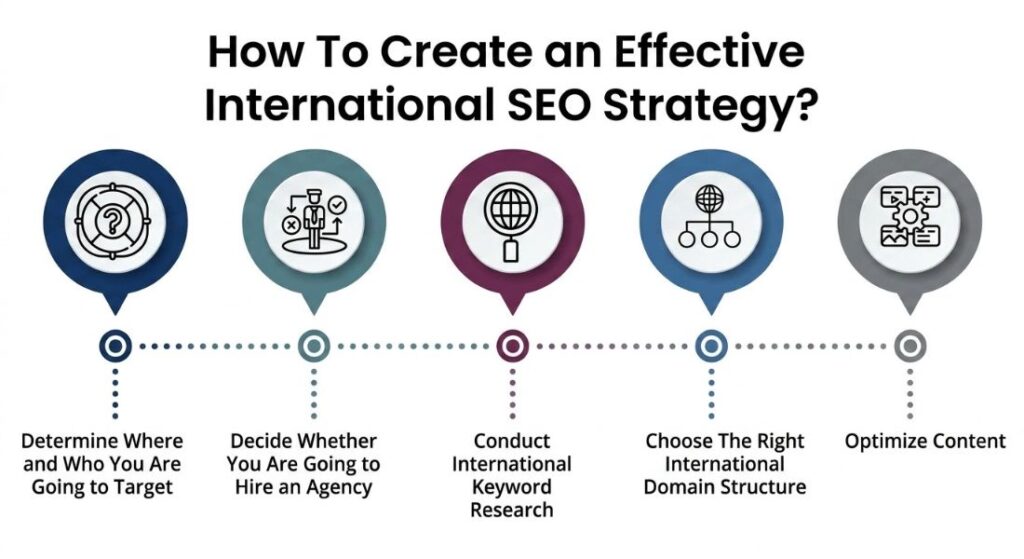
Going global sounds exciting but rankings do not follow automatically.
If people in other countries are not searching the way you optimized your traffic stays flat.
Most brands fail here because they translate keywords instead of understanding real search behavior.
That mistake quietly kills visibility in markets like Germany, Japan and Brazil.
This guide shows you how to find the exact keywords intent and structure needed to rank in any market based on how people actually search not how you assume they do.
What International SEO Keyword Research Actually Means (And Why Most Brands Get It Wrong)?
International SEO keyword research is the process of identifying the exact words and phrases that real people in specific countries or language markets type into search engines when looking for your products, services or content.
Notice what that definition does not say: it does not say “translate your existing keywords.”
That is the most common mistake and it costs rankings fast because translated keywords often fail to match how users naturally search.
Search behavior is shaped by culture habits and language patterns. If your keywords do not align with those your content becomes invisible no matter how well it is optimized technically.
How Does It Differ From Regular Keyword Research?
When you do keyword research for your home market you rely heavily on intuition. You understand how people talk about what words they prefer and how they express problems or needs.
In international markets that advantage disappears. You depend almost entirely on data and without cultural context that data can mislead you.
A keyword with strong volume only shows activity not relevance or intent. It does not tell you whether users are looking for what you offer.
For example “sports shoes” translated into Spanish becomes “zapatos deportivos” but in Spain users commonly search “zapatillas deportivas.” In Mexico it changes again.
Same product, same language, different behavior. If you rely on translation instead of real usage patterns you lose visibility before you even start because your content is built on the wrong signals.
Translation vs Localization vs Transcreation: The Three Are Not the Same!
Translation replaces words from one language to another. It is literal and often ignores how people actually speak. Localization adapts those words to match cultural and regional usage including tone phrasing and vocabulary. It brings content closer to how people naturally communicate.
Transcreation goes further. It rebuilds the idea based on how people think, search and make decisions in that market. It focuses on intent rather than wording. This matters because many concepts do not translate directly across markets.
For example “Laufschuhe für Frauen” has very low demand in Germany while “Laufschuhe Damen” has significantly higher search volume. The difference is not language accuracy. It is behavioral accuracy.
Transcreation ensures your keywords match how users actually search which directly impacts both rankings and conversions.
Before You Touch Any Tool: Define Your Market Correctly!
Most international SEO strategies fail before research even begins.
People jump into tools without defining what they are targeting which leads to scattered and ineffective keyword lists. The first decision is simple but critical: are you targeting a country or a language?
Country Targeting vs Language Targeting
Language targeting focuses on users who search in a specific language regardless of location.
Country targeting focuses on users in a specific region where factors like pricing currency logistics and regulations influence search behavior. Both approaches are valid but they lead to different keyword strategies.
A keyword that works across all French-speaking users may not work for users in France specifically if their intent is shaped by local conditions.
Your targeting decision affects keyword selection content structure and even how your pages are organized.
Why “Spanish” Is Not a Market (And What to Do Instead)?
Spanish is spoken across multiple countries but search behavior differs significantly between them. Vocabulary cultural references and even intent vary by region.
For example “coche eléctrico” is common in Spain while users in Mexico might search “auto eléctrico” or “carro eléctrico.”
These differences are not small. They directly impact which pages rank. If you treat Spanish as one market your keyword strategy becomes too generic and misses real opportunities.
Instead define each target country clearly before research. List the country language variation and any specific user behavior patterns. This becomes the foundation for accurate keyword research.
The Complete International Keyword Research Process
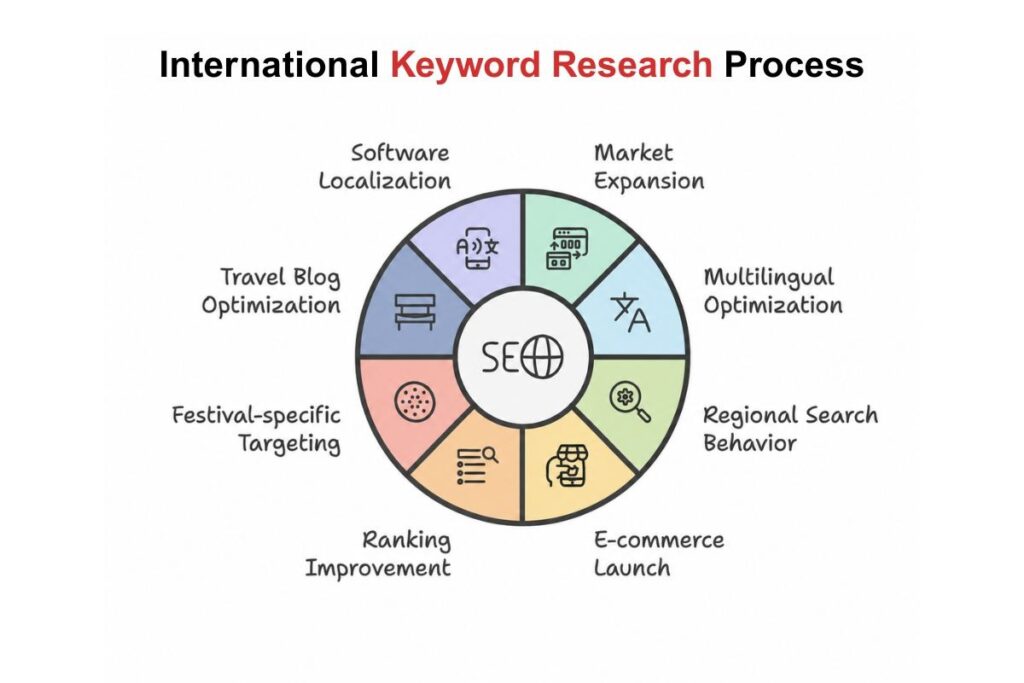
Step 1: Find Who Is Already Ranking in That Country (Not Yours)
Your competitors change depending on the country.
Websites ranking in Germany are not the same as those ranking in the US even for the same topic.
Switch your SEO tool to the target country and analyze top-ranking pages.
Look at what topics they cover, how deeply they explain them and which keywords drive their traffic.
This shows you the actual standard required to compete in that market.
Paid keyword data adds another layer. If competitors are investing in specific keywords it signals strong commercial intent and proven value.
Step 2: Build Your Native Keyword List Without Speaking the Language!
Native understanding always produces better keyword ideas because it reflects real usage.
If possible ask someone from that market how they would search for your product or problem. Their responses often reveal phrases tools miss.
If native input is not available you can still build a strong list using indirect sources.
Local forums and discussion platforms show how people naturally talk about problems. This language often translates directly into long-tail keywords.
AI tools can generate variations but they should only be used as a starting point not a final source. Translation tools like DeepL can help uncover better phrasing options than basic translators.
The goal is to collect keywords that reflect real human behavior not mechanical translations.
Step 3: Validate With Country-Specific Data
Once you have keyword ideas, validation is essential. Global search volume is misleading because it does not represent demand in a specific market. A keyword with high global volume may have very little activity in your target country.
Always filter data by country and check search volume competition and trends locally.
This step ensures your strategy is based on real demand not assumptions.
Step 4: The Local SERP Eye Test (The Step Most SEOs Skip)
- Data alone is not enough. You must analyze actual search results.
- Search from the target country’s perspective and study what ranks.
- Look at the format of content, how detailed it is and the tone used.
These results reflect what users expect and what search engines prioritize.
If the results do not match your intended topic the keyword is likely incorrect.
This step also helps identify misleading keywords that appear relevant but lead to different types of content.
Step 5: Check Keyword Intent Country by Country
The same keyword can have different meanings in different markets. Intent depends on local systems culture and user expectations. A keyword might represent a buying query in one country and an informational query in another.
Before finalizing any keyword, understand what users actually want when they search.
Your content must align with that intent to rank effectively and convert traffic into results.
Step 6: Build Keyword Clusters for Each Language Version
Keyword clustering groups related terms under a single topic. This allows one page to rank for multiple variations instead of targeting each keyword separately.
In international SEO clusters must be created separately for each market. You cannot translate clusters from one language and expect them to perform in another.
Each market has different subtopics priorities and expectations. Localized clusters ensure your content aligns with how users think and search in that specific region.
The False Friend Trap That Silently Kills International Rankings
False friends are words that look similar across languages but have different meanings.
They can completely distort your keyword strategy. A keyword might appear relevant but actually attract an unrelated audience.
If you optimize for it your content will rank for the wrong searches and fail to convert.
The simplest way to detect this is through SERP analysis.
If search results do not match your topic the keyword is misleading. Ignoring this step often leads to wasted effort and poor performance.
Non-Google Markets – Baidu Naver Yandex Yahoo Japan
Not every market relies on Google as the primary search engine. Different regions have their own platforms with unique ranking systems.
Baidu dominates China and emphasizes local hosting speed and language accuracy.
Naver in South Korea functions more like a content ecosystem where internal platforms influence visibility.
Yandex in Russia uses its own ranking logic and tools.
Yahoo Japan still plays a role with distinct user behavior patterns.
Each platform requires a tailored approach. Standard strategies do not always transfer directly.
Best Tools for International Keyword Research
Keyword tools become significantly more effective when combined with proper targeting.
Platforms like Semrush and Ahrefs provide detailed country-level data and competitor insights.
Google Keyword Planner helps validate demand at a basic level.
Google Trends reveals regional interest and seasonal patterns. Translation tools and local sources add context that tools alone cannot provide. The strongest strategies combine multiple data sources with real-world language understanding.
How AI Search Is Reshaping International Keyword Strategy in 2026?
AI-driven search is changing how users interact with information. Many informational queries are now answered directly in search results, reducing clicks. This impact varies by region depending on adoption and rollout speed. As a result ranking alone is no longer enough.
Content must provide deeper value that goes beyond simple answers. This includes local insights, unique perspectives and information that cannot be easily summarized. The shift makes high-quality market-specific content more important than ever for maintaining visibility.
The Most Common International SEO Keyword Mistakes
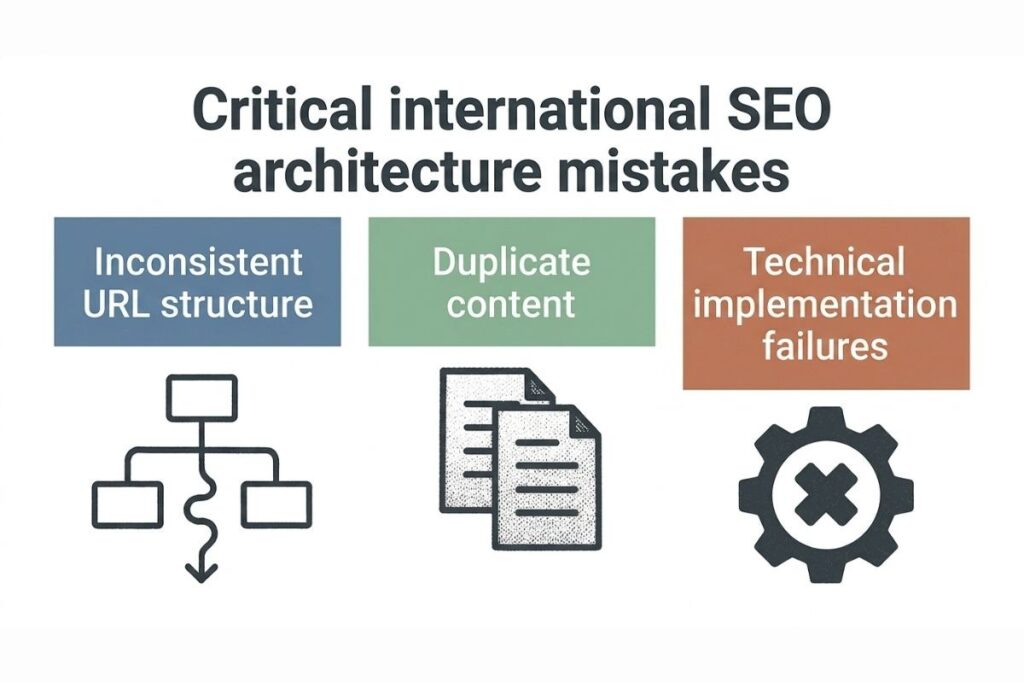
Many brands repeat the same patterns that limit their success. Treating language as a market leads to inaccurate targeting. Using global search volume creates unrealistic expectations.
Ignoring updates causes strategies to become outdated over time.
Long-tail keywords are often overlooked because they require deeper localization but they usually bring more qualified traffic. Technical elements like hreflang help with targeting but they cannot fix poor keyword selection. Relevance and intent always matter more than technical setup.
FAQs
How is international SEO keyword research different from just translating keywords?
Translation changes words, not behavior. International research focuses on real user search patterns intent and local validation.
Can I do international keyword research without speaking the target language?
Yes but accuracy improves with native input. Use tools, forums and validation methods to reduce errors.
Why does the same keyword have different intent in different countries?
Intent depends on local culture systems and user expectations. Always analyze search results to understand it properly.
How often should international keyword research be updated?
Review it regularly ideally every few months. Search behavior evolves differently across markets.
What is transcreation and when do I need it for keyword research?
Transcreation rebuilds the keyword idea based on real user behavior. Use it when translation does not reflect how people actually search.