You write great content, target the right keyword and still watch competitors outrank you. The missing piece is almost always the same thing: semantic depth.
Understanding LSI keywords, what they actually are, how search engines really process them and how to use related terms correctly is what separates content that ranks from content that sits on page three forever.
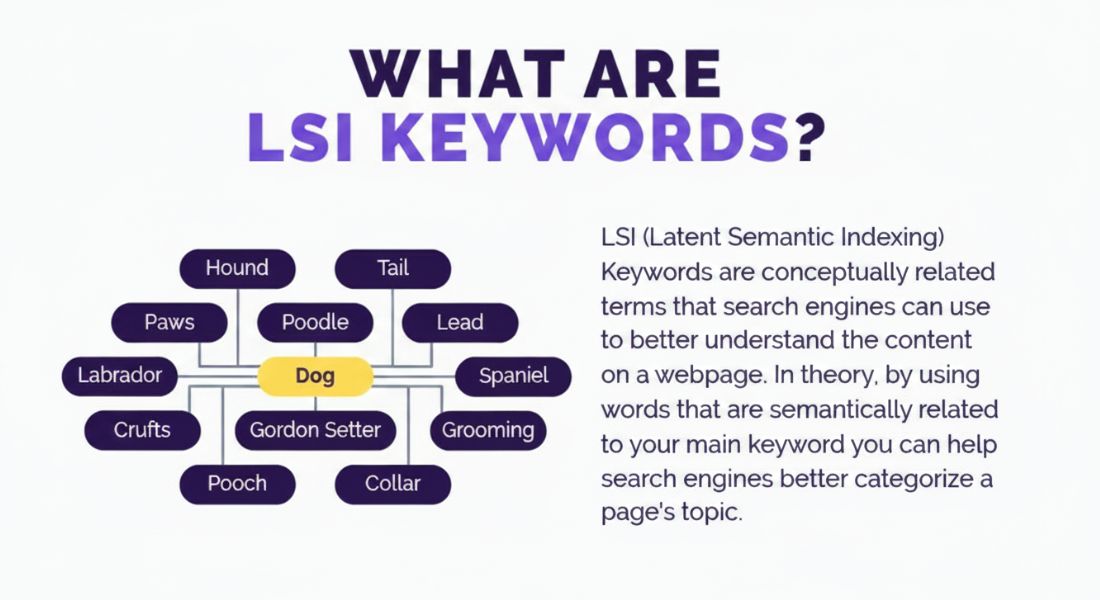
What Are LSI Keywords?
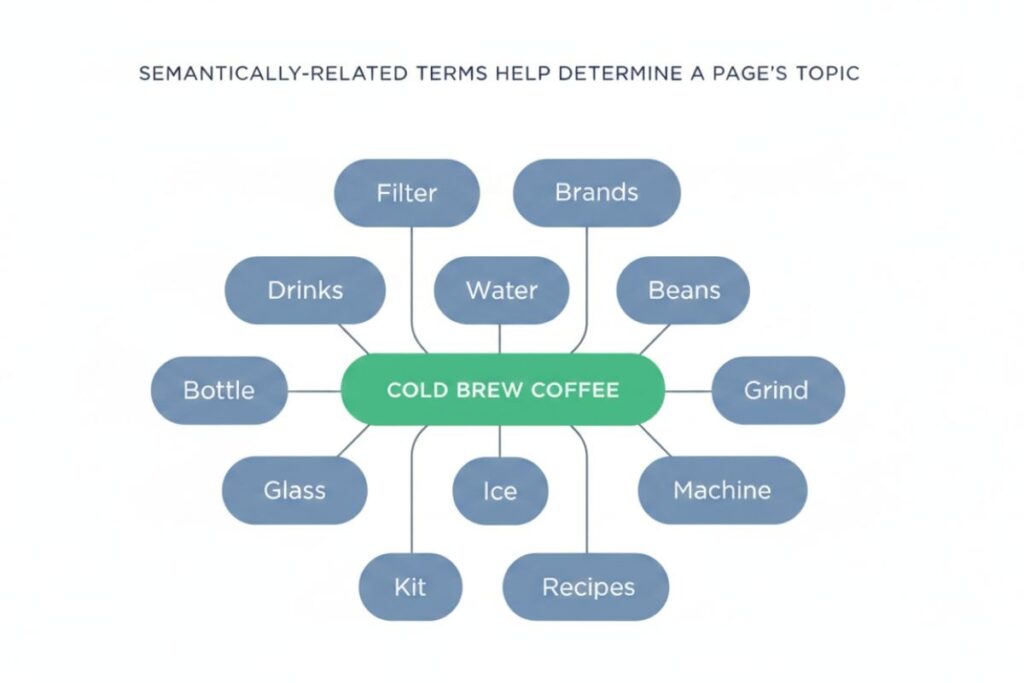
LSI stands for Latent Semantic Indexing. LSI keywords are conceptually related terms that help search engines understand the context of your content. Although Google does not use LSI technology, using semantic keywords improves topical relevance, increases rankings and helps pages appear for multiple related search queries.
Take the keyword digital marketing. Related semantic terms would include target audience conversion rate content strategy brand awareness and organic traffic. None of these mean digital marketing. All of them belong to the same topical space.
This distinction matters more than most people realize. Synonyms are alternative labels for the same thing. Semantic keywords are related concepts that together paint a complete picture of your topic. Google reads that full picture to understand what your page is genuinely about.
Classic example: the word Apple. If your page contains iPhone iOS MacBook and App Store Google categorizes it as a tech company page. If it contains orchard cider harvest and vitamin C Google knows you mean the fruit. Neither interpretation comes from the word Apple alone. The surrounding semantic context delivers the meaning.
Does Google Use LSI Keywords?
No. Google has stated this directly.
John Mueller from Google confirmed in 2019 that there is no such thing as LSI keywords and that anyone claiming otherwise is mistaken. LSI was a technology developed at Bell Labs in 1988 designed for small static document databases.
Google indexes hundreds of billions of pages across a living constantly changing web. That 1988 technology does not scale to what Google operates today.
Google patent researcher Bill Slawski spent years analyzing Google patents and found no evidence of latent semantic indexing in Google systems. What he did find were entirely different and far more advanced methods.
So the term LSI keywords is technically inaccurate. But here is what matters: the practice of using semantically related language in your content is completely valid and genuinely improves rankings. The label is wrong. The underlying concept works.
What Google Uses Instead
Understanding what Google actually does gives you a real advantage over competitors still chasing outdated terminology.
Natural Language Processing (NLP): Google uses NLP to read content the way a human expert would. It analyzes meaning, intent and context rather than counting keyword occurrences. It can distinguish between literal and figurative language, understand polysemous words (words with multiple meanings) and interpret the overall topic of a page from its full text.
Knowledge Graph: Google maintains a semantic network of entities and their relationships. Entities include people, places , products , concepts and organizations. When Google reads your content it maps your language to this graph and builds an understanding of your topic at an entity level well beyond simple keyword matching.
Phrase-Based Indexing: Documented in over 20 Google patents since 2004 this system identifies complete phrases that frequently co-occur on pages about specific topics. A page about the President of the United States naturally contains phrases like oval office secretary of state and executive branch. Google indexes these co-occurrence patterns and uses them to evaluate topical relevance.
Context Vectors: Another Google patent system that uses domain-specific terms to resolve ambiguity. The word horse means something different to an equestrian, a carpenter and a gymnast. Adding terms like saddle stirrups and thoroughbred helps Google confidently understand which meaning applies to your page.
Hummingbird and RankBrain: Hummingbird launched in 2013 shifted Google toward understanding the intent behind a query rather than its literal words. RankBrain applies machine learning to interpret queries it has never encountered before by mapping them to concepts it already understands. Together they allow Google to process language at a genuinely conceptual level.
Why Semantic Keywords Still Matter for Rankings?
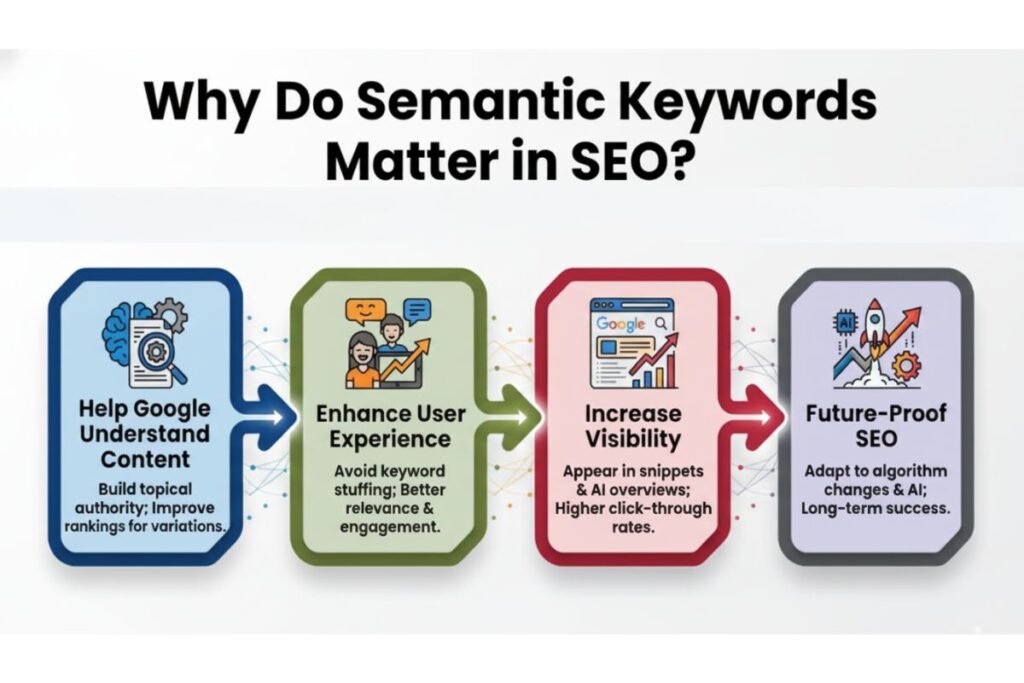
Even though Google does not use LSI technology semantic richness directly impacts how well Google understands and ranks your content.
In early SEO, keyword density determined rankings. Repeat your target keyword enough times and you are ranked. Google ended that era by shifting focus from repetition to relevance. Now instead of measuring how often you mention a term Google evaluates how thoroughly you cover the topic surrounding it.
Two pages targeting email marketing as their primary keyword. One covers only the phrase itself repeated throughout thin paragraphs. The other naturally discusses subscribers’ open rates segmentation, deliverability automation sequences and campaign analytics.
Google sees the second page as authoritative coverage of the topic and ranks it higher often for dozens of related queries the writer never specifically targeted.
That compounding effect is the real value of semantic optimization. One well-structured semantically rich page can rank for hundreds of search variations. Keyword-stuffed thin content ranks for almost none of them.
How to Find Semantic and LSI Keywords?
Google Autocomplete: Type your primary keyword into Google and study the dropdown suggestions. Those bold terms come from real user search behavior and represent the language Google most associates with your topic. They are free current and highly reliable.
People Also Ask: The PAA box in search results surfaces the exact questions real users ask around your topic. Each question contains semantic terms and content angles your page should address. Answering PAA questions also increases your chances of winning featured snippets.
Related Searches: Scroll to the bottom of any search results page. The related searches section shows alternative queries Google considers semantically connected to your keyword. These represent different vocabulary and subtopics your audience actually uses.
Google Images Tags: Search your keyword in Google Images and examine the filter tag chips above the results. These tags reflect exactly what Google considers related to your search and are an underused source of semantic keyword ideas.
Google Keyword Planner: Enter a competitor URL rather than a keyword and Google analyzes that page and returns terms it considers topically relevant. This reverse-engineering technique surfaces semantic terms you would not find starting from your own keyword alone.
Ubersuggest: Neil Patel’s free tool that surfaces keyword ideas, search volume and related terms around any seed keyword. It works well for beginners who want a clean simple interface without the complexity of enterprise-level tools.
LSI Graph: A free tool specifically built for semantic keyword discovery. Enter your keyword and get a structured list of conceptually related terms. Useful for quick ideation at the content planning stage.
Semrush SEO Content Template: Analyzes the top ten pages ranking for your keyword and extracts the semantic terms they share. It effectively shows you what Google expects to see in content that ranks for your target.
Ahrefs Keywords Explorer: Surfaces related terms question-based keywords and topic clusters around any seed keyword. Useful for building a complete semantic map before writing.
How to Use LSI Keywords in Your Content
Write naturally first. If you know your topic most semantic terms will appear without effort. Complete a thorough draft before worrying about optimization then review for gaps.
Place terms in high-signal areas. Title tags H1 headings H2 subheadings and the opening paragraph carry the most weight. If a semantically related term fits naturally in your title or a key subheading use it there.
Distribute throughout the body. Avoid clustering all related terms in one section. Spread them across the full piece so Google builds a consistent semantic picture from start to finish.
Use terms in image alt text. Accurate image descriptions introduce related vocabulary that adds to your page context without disrupting the reading experience.
Cover subtopics not just keywords. The strongest semantic signal is not a list of inserted terms but complete subtopic coverage. Each major section of your content should represent a genuine angle that belongs to the overall topic. That structure signals topical completeness to Google. For example if you are writing about web development services covering sections on responsive design page load speed CMS platforms and UI/UX best practices tells Google your page addresses the full scope of the subject rather than just repeating a single phrase throughout.
Use them in anchor text. When you link internally between pages the anchor text you choose sends a topical signal to Google about the destination page. Using a semantically related term as anchor text rather than a generic phrase like click here helps Google understand what the linked content is about and strengthens the overall topical relevance of your site structure.
Avoid forcing terms that do not fit. If a related keyword reads awkwardly in context leave it out. Forced optimization is immediately detectable to both readers and search engines.
Key Benefits of Semantic Keyword Optimization
Broader ranking footprint. Semantically rich pages rank for dozens of related queries beyond the primary keyword. One well-optimized page can drive consistent traffic from hundreds of search variations.
Stronger topical authority. Google rewards sites that demonstrate genuine expertise across an entire subject area. Semantic depth signals that your content was written by someone who actually understands the topic.
Better user experience. Content that covers a topic with appropriate vocabulary and depth is more informative and satisfying. Lower bounce rates and longer session times follow naturally both of which send positive signals back to Google.
Reduced over-optimization risk. Using a range of semantically related terms naturally distributes your vocabulary. You are far less likely to repeat any single phrase to the point where it looks manipulative.
Faster topical indexing. When Google crawls a new page semantic richness helps it categorize the content faster and more accurately which means quicker inclusion in relevant search results.
Semantic SEO, Topical Authority and Content Clusters

Semantic keyword optimization works best as part of a broader topical authority strategy.
Instead of publishing isolated articles around single keywords, build content clusters. A pillar page covers a broad topic comprehensively. Supporting pages go deep on specific subtopics. Internal links connect everything. Each page is semantically optimized for its specific angle.
An SEO services site for example might have a pillar page on SEO fundamentals supported by individual pages covering keyword research, on-page optimization, technical SEO link building and content strategy.
Each supporting page is semantically rich for its subtopic and links back to the pillar. Google sees a coherent network of genuinely useful content and rewards the entire cluster with stronger domain authority.
This is where semantic SEO stops being a page-level tactic and becomes a site-level competitive advantage.
Conclusion
The term LSI keywords may be technically outdated but the practice behind it is one of the most reliable things you can do for your rankings. Write content that covers your topic the way a real expert would. Use the natural vocabulary of your subject. Address the questions your audience is actually asking.
Google has spent years learning to read content like a human does. The best response to that is to write like one. Thoroughly natural, genuinely useful. That is the kind of content that holds rankings across algorithm updates not because it gamed a system but because it actually deserved to rank.
Pick one piece of your existing content today and run it through the methods in this guide. See what semantic gaps exist and fill them. The difference in performance will make the approach very easy to believe in.
FAQs
What is the difference between LSI keywords and long-tail keywords?
LSI keywords are conceptually related terms that add semantic depth to your content around a main topic. Long-tail keywords are specific lower-competition search phrases that users type when they have a very clear search intent. Both matter for SEO but they serve different purposes in your keyword strategy.
Should I use LSI keywords in meta descriptions and title tags?
Yes, when they fit naturally. Including semantically related terms in your title tag and meta description helps Google confirm your page topic and can increase your click-through rate when those terms match a user query and appear bolded in search snippets. Never force them where they sound unnatural.
Do LSI keywords work differently for ecommerce product pages vs blog content?
Yes, for blog content semantic terms expand topical coverage and drive informational traffic. For ecommerce product pages related terms like product specifications materials use cases and buyer intent phrases help Google match your page to transactional queries and improve conversion-focused rankings.
Can LSI keywords help reduce keyword cannibalization on my website?
Absolutely, When each page on your site uses a distinct set of semantically related terms around a unique angle Google can clearly differentiate between your pages. This reduces the risk of multiple pages competing for the same query which is one of the most common causes of ranking drops on content-heavy websites.
How do LSI keywords affect Google E-E-A-T signals?
Strong semantic coverage directly supports Experience Expertise Authoritativeness and Trustworthiness signals. Content that uses accurate topic-specific vocabulary naturally reads like it was written by a genuine expert. Google rewards that depth especially in YMYL niches like finance, health and legal services.