SEO ROI is one of those topics that sounds simple on the surface but gets complicated the moment you try to apply it in real business decisions. Most people think it is just a formula. Some traffic, some revenue, a bit of math and you are done.
In reality, SEO ROI is closer to a business performance system than a marketing metric. It connects search visibility, customer behavior conversion tracking and long-term revenue growth into one continuous loop.
If you understand SEO ROI properly you stop asking whether SEO works and start asking how efficiently it is working compared to your other channels. That shift alone changes how businesses allocate budgets and scale growth.
What is SEO ROI?
SEO ROI is the return on investment from search engine optimization. It measures how much revenue your organic search efforts generate compared to the total cost spent on SEO activities. A positive SEO ROI means your organic revenue is higher than your SEO investment.
What SEO ROI Really Means in Business Terms?
SEO ROI is not just about ranking higher on Google or getting more traffic. It is about how much financial return your organic search efforts generate compared to what you spend on them.
At its core SEO ROI answers one question. For every dollar you invest in SEO how much money do you get back.
The basic logic is simple. You invest in content technical SEO optimization and tools. In return you receive organic traffic. That traffic converts into leads or sales. Those conversions generate revenue. The gap between revenue and cost is your return.
However what most beginners miss is that SEO does not behave like paid advertising. It does not produce instant and isolated results. It compounds over time.
A page you publish today can generate traffic and revenue for years without additional cost which is why SEO ROI is often higher in the long run compared to paid channels.
The SEO ROI Formula Explained in Simple Terms
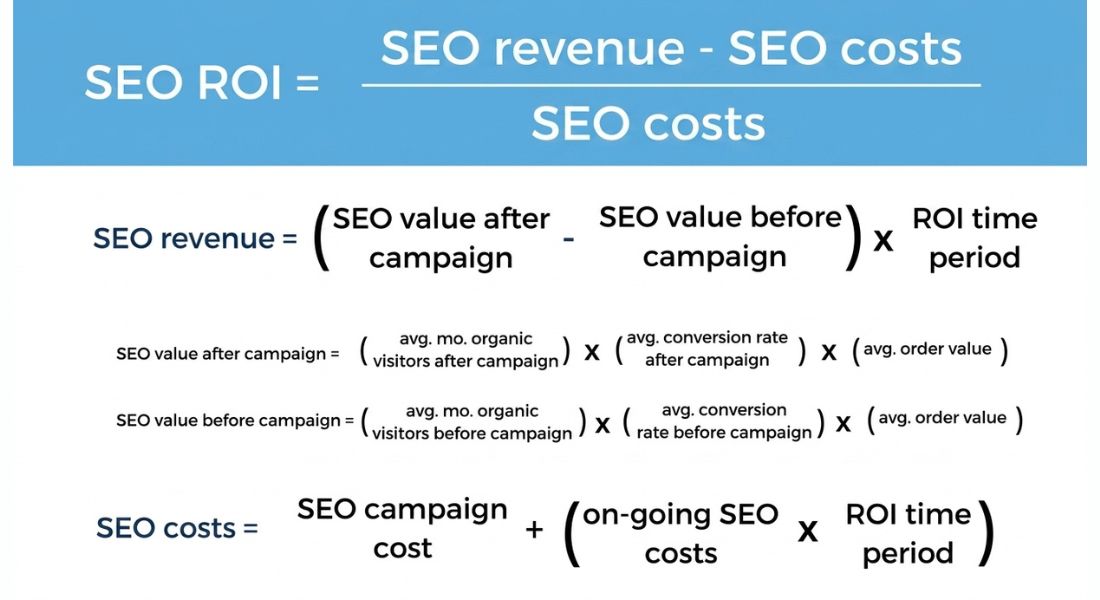
The most commonly used formula for SEO ROI is straightforward.
SEO ROI equals revenue from SEO minus SEO cost divided by SEO cost multiplied by 100.
This gives you a percentage that shows whether your investment is profitable.
For example if you spend ten thousand dollars on SEO and generate fifty thousand dollars in organic revenue your ROI is four hundred percent. That means you earned four times what you invested.
But this is where many people stop and that is where the misunderstanding begins.
The formula only works when you can accurately measure both cost and revenue. And in SEO both of these are more complex than they appear.
Cost includes content creation SEO tools, technical work, freelancers agencies and internal team time. Revenue includes not just direct sales but also assisted conversions where SEO plays a role earlier in the customer journey.
This is why SEO ROI is not just a math problem. It is an attribution problem.
How Businesses Actually Measure SEO ROI in 2026?
Modern SEO ROI measurement is built on tracking systems rather than simple calculations. Businesses rely on tools like Google Analytics 4, Google Search Console and CRM platforms to connect organic traffic to actual revenue outcomes.
In ecommerce businesses SEO ROI is easier to measure because transactions are directly tracked. You can see which organic sessions resulted in sales and how much revenue they generated.
In B2B businesses the process is more layered. A visitor might land on a blog return later through a branded search then finally convert through a demo request. SEO may not be the last touchpoint but it influenced the entire journey.
This is where customer lifetime value becomes important. Instead of measuring just the first sale, businesses look at how much a customer is worth over time. SEO often attracts higher intent users who convert into long-term clients which increases actual ROI significantly compared to surface level tracking.
Another important factor is attribution modeling. SEO rarely works alone. It interacts with paid ads, email marketing and direct traffic. Modern measurement systems try to distribute credit across all touchpoints instead of assigning it to a single channel.
The Hidden Factors That Impact SEO ROI Most People Ignore
Most discussions about SEO ROI focus on traffic and rankings but the real drivers of profitability are deeper.
Search intent is one of the most important factors. High traffic keywords do not always produce high ROI. Keywords with clear buying intent generate fewer visits but significantly higher revenue.
Content quality also plays a major role. A well structured in depth page builds trust and increases conversion rates. Thin content might rank temporarily but rarely delivers strong ROI.
Technical SEO is another hidden factor. Website speed, mobile experience and crawlability directly affect rankings and user behavior. Even small improvements in load time can increase conversions which improves ROI without increasing traffic.
Finally keyword targeting strategy determines efficiency. Many businesses chase volume instead of value. High volume keywords often attract informational traffic that does not convert well. High intent keywords may have lower volume but significantly higher return.
SEO ROI vs PPC ROI
SEO and PPC both generate traffic but their ROI structure is completely different.
PPC delivers immediate results. You pay for every click and the moment you stop paying traffic disappears. SEO takes longer to build but continues delivering returns without ongoing cost per click.
Over time SEO usually becomes more cost efficient. The reason is simple. Paid traffic scales with budget. Organic traffic scales with content and authority.
However PPC is easier to control and measure in the short term. SEO requires patience and consistent investment before it reaches peak performance.
Most high performing businesses use both. PPC for immediate acquisition and SEO for long term compounding growth.
Realistic SEO ROI Timelines
SEO ROI does not appear overnight. In most cases early signals appear within a few months but meaningful financial returns usually take six to twelve months depending on competition and website strength.
In competitive industries it can take longer. The reason is simple. SEO is not just about publishing content. It is about building authority in Google’s ecosystem.
Once that authority builds, ROI begins to compound. A single piece of content can continue generating leads and revenue for years. This compounding effect is what makes SEO one of the highest ROI digital channels when executed properly.
How to Improve SEO ROI Step by Step?
Improving SEO ROI is less about doing more SEO and more about doing the right SEO.
The first step is focusing on high intent keywords instead of high volume keywords. This ensures that traffic has real conversion potential.
The second step is improving existing content instead of only creating new pages. Many websites already have ranking pages that can be optimized for better conversions and higher traffic.
The third step is strengthening conversion tracking. Without accurate data ROI becomes guesswork. Businesses need clear visibility into which pages and keywords actually generate revenue.
The fourth step is improving user experience. If visitors land on a page and leave immediately rankings alone will not save ROI. Engagement and conversion rates matter just as much as traffic.
Common Mistakes That Destroy SEO ROI
One of the biggest mistakes businesses make is treating SEO as a short term tactic. They expect fast returns and stop investing too early. SEO requires consistency before it becomes profitable.
Another mistake is over investing in tools while under investing in content and strategy. Tools help analysis but they do not create value on their own.
Many businesses also focus too much on rankings and not enough on revenue. Ranking number one for a keyword means nothing if it does not convert.
Finally poor technical foundations can silently destroy ROI. Even strong content cannot perform well on a slow or poorly structured website.
Conclusion: Is SEO ROI Worth It?
SEO ROI is not just about whether SEO works. It is about how efficiently your business turns search visibility into revenue.
When done correctly SEO becomes a compounding asset. It reduces customer acquisition costs over time, builds brand authority and creates a stable long term traffic source that does not depend on continuous ad spend.
The real advantage of SEO is not instant profit. It is scalable predictable growth that increases in value the longer you invest in it.
Businesses that understand this shift stop treating SEO as an expense and start treating it as a revenue system. And that is where true ROI begins to show its real power.
FAQs
Can SEO ROI be negative and why does it happen?
Yes SEO ROI can be negative when the cost of SEO is higher than the revenue it generates. This usually happens when businesses target wrong keywords, publish low-quality content or stop SEO too early before it starts compounding. Poor tracking also makes ROI look worse than it actually is.
What is considered a good SEO ROI in most industries?
A good SEO ROI typically ranges from 300% to 1000% depending on industry competition and customer lifetime value. High-ticket industries like SaaS finance and legal services often see much higher returns compared to ecommerce or local businesses. However ROI should always be evaluated relative to acquisition cost not a fixed number.
Why does SEO ROI vary so much between businesses?
SEO ROI varies because every business has different factors like pricing conversion rate, sales cycle length and competition level. A business selling high-value services will naturally see higher ROI compared to low-margin products. Technical setup and content strategy also heavily influence results.
How does SEO ROI change when you scale SEO efforts?
As SEO scales ROI usually improves over time because content builds authority and rankings compound. Early stages often require investment without immediate returns but once visibility increases traffic and conversions grow without proportional cost increases. This is where SEO becomes highly profitable long term.
Can SEO ROI be accurately predicted before starting a campaign?
SEO ROI can be estimated but never predicted with full accuracy because search rankings competition and user behavior constantly change. However businesses can use keyword value conversion rates and historical data to create realistic ROI projections. These forecasts become more accurate after 3–6 months of performance data.