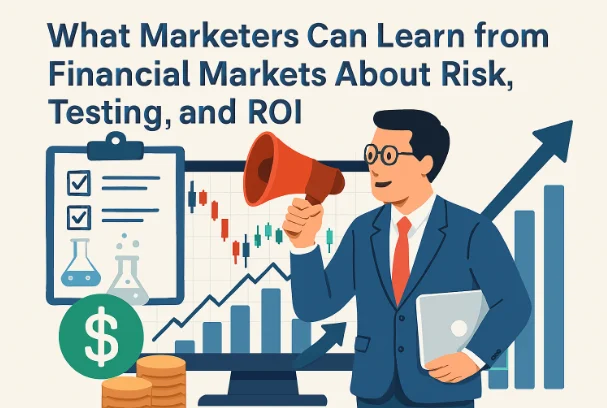
Marketing and financial trading may look like two completely different worlds on the surface. One focuses on brand growth, audience engagement, and conversions, while the other revolves around charts, numbers, and market movements. Yet when you look deeper, both disciplines are driven by the same core principles: managing risk, testing assumptions, and measuring return on investment with discipline rather than emotion.
Seasoned traders survive not because they predict markets perfectly, but because they control downside risk, follow structured testing, and respect probabilities. Marketers who want consistent growth can learn a great deal from this mindset, especially in an era where ad costs are rising, algorithms change frequently, and short-term wins often come at the expense of long-term stability.
“Success comes from managing uncertainty, not eliminating it.”
Platforms like Independent Investorhighlight this reality in the trading world by emphasizing risk awareness, realistic expectations, and informed decision-making. Those same ideas translate surprisingly well into modern marketing strategy, including areas like affiliate marketing, where ROI depends on measured risk, partner selection, and performance tracking.
Risk Is Not the Enemy, Mismanaged Risk Is
In financial markets, risk is unavoidable. Every trade carries uncertainty, and even the best setups fail sometimes. Professional traders do not try to eliminate risk entirely. Instead, they define it clearly before entering a position.
They decide in advance:
- How much they are willing to lose
- Where the trade becomes invalid
- How large the position should be relative to total capital
Marketing operates under similar conditions, even if it is not always treated that way. Every campaign carries risk:
- Paid ads may not convert
- Influencer partnerships can miss the audience
- SEO takes time and may not rank as expected
- Messaging can resonate or fall flat
The key lesson from trading is simple:
“Risk should be measured, not ignored.”
Smart marketers treat campaigns like controlled experiments rather than all-or-nothing bets. Instead of allocating an entire budget to one untested channel, they start small, gather performance data, and scale only what proves itself.
This mirrors how traders risk only a small percentage of their capital on a single trade, ensuring survival even when outcomes are unfavorable.
When marketing efforts fail, it is rarely because risk existed. It is because risk was undefined, underestimated, or emotionally justified.
The Discipline of Testing Before Scaling
One of the most overlooked parallels between marketing and trading is testing discipline.
In financial markets, traders:
- Backtest strategies on historical data
- Paper trade before risking real capital
- Track metrics like win rate, drawdown, and expectancy
- Refine rules before increasing exposure
Marketing teams often talk about testing, but execution is inconsistent. Campaigns are sometimes judged too quickly or based on surface-level metrics.
A trader would never abandon a strategy after a few losses. They understand that outcomes need a statistically meaningful sample size.
The same applies to marketing:
- One underperforming ad does not invalidate a channel
- One slow-ranking blog post does not mean SEO is failing
- One quiet week does not mean a campaign is dead
“Testing only works when you give it time to fail properly.”
Effective testing requires consistency, controlled variables, and patience. This is why platforms like Independent Investor frequently remind traders that no strategy guarantees consistent returns. That truth applies directly to marketing.
No funnel, ad format, or growth hack works forever. Continuous testing and adaptation are the only sustainable advantages.
Risk-to-Reward Thinking Changes Everything
One of the most powerful concepts traders use is risk-to-reward ratio.
Before entering a trade, they ask:
- How much can I lose if this fails?
- How much can I gain if it succeeds?
- Is the upside worth the downside?
If the math does not make sense, the trade is skipped.
Marketers often reverse this logic. Campaigns get launched based on excitement, trends, or competitive pressure rather than clear upside-downside analysis.
Applying risk-to-reward thinking forces better questions:
- What is the maximum downside of this campaign?
- What is the realistic upside, not the best-case scenario?
- Is this worth the time, budget, and team focus?
“Not every opportunity deserves execution.”
This mindset also helps marketers walk away earlier from bad ideas. In trading, cutting losses is a survival skill. In marketing, teams often hold onto failing campaigns due to sunk costs, pride, or internal expectations.
Financial markets teach that protecting capital matters more than being right.

Applying Trading Principles to Affiliate Marketing
Just like traders evaluate risk, ROI, and strategy before entering the market, affiliate marketers must approach partnerships with the same level of discipline. Treating affiliate campaigns like carefully measured trades ensures long-term growth instead of chasing short-term gains. Key practices include:
• Partner Selection: Evaluate affiliates based on audience alignment, past performance, and reliability.
• Commission Structure Analysis: Balance potential returns against payout costs to avoid overexposure.
• Testing Campaigns: Start small with new affiliates or products, measure performance, and scale what works.
• Tracking Metrics: Monitor click-through rates, conversion rates, and revenue per partner to refine strategy.
• Risk Management: Avoid putting too much budget into untested affiliates, similar to limiting position size in trading.
Platforms like Independent Investor emphasize structured testing, clear risk parameters, and informed decisions—principles that translate seamlessly to affiliate marketing, allowing campaigns to scale sustainably while minimizing unexpected losses.
Emotional Control Is a Competitive Advantage
Financial markets punish emotional decision-making quickly. Fear leads to early exits, greed leads to overexposure, and impulsive decisions wipe out accounts.
Experienced traders rely on predefined rules to remove emotion from execution.
Marketing is emotional too, just less visibly:
- Chasing trends because competitors are doing it
- Increasing budgets after short-term success
- Killing campaigns too early after temporary dips
The lesson is not to remove creativity, but to separate creativity from evaluation.
Traders allow creativity in strategy development, but execution follows rules. Marketers benefit from the same separation.
“Creativity fuels ideas. Discipline determines results.”
When teams stop reacting to every metric swing, consistency improves and burnout decreases.
ROI Is About Probability, Not Guarantees
One of the biggest misconceptions in both marketing and investing is the search for certainty.
There are no guaranteed strategies.
Financial education platforms like Independent Investor consistently reinforce that losses are part of the process. Traders aim for positive expectancy over time, not perfection.
Marketing ROI works the same way:
- A winning strategy does not win every time
- A losing campaign does not mean failure overall
- Long-term performance matters more than individual outcomes
This perspective builds resilience. Instead of abandoning strategies during normal drawdowns, marketers refine targeting, messaging, and execution within proven frameworks.
“Profitability is a long-term pattern, not a single result.”
Capital Preservation Enables Long-Term Growth
In trading, survival comes first. Without capital, there is no opportunity to recover.
The same applies to marketing budgets, especially for startups and growing businesses.
Aggressive spending without validation often leads to early exhaustion. Financial markets reward steady growth and punish over-leverage.
Marketers who think like traders:
- Validate before scaling
- Monitor downside continuously
- Protect budgets as strategic assets
Because they are.
Data Is Only Valuable When Interpreted Correctly
Traders use data heavily, but they understand its limits. Indicators provide context, not certainty.
Marketing analytics faces similar challenges. Metrics such as:
- Click-through rates
- Engagement
- Impressions
- Conversions
are useful, but misleading when viewed in isolation.
Effective marketers evaluate:
- Attribution models
- Customer lifetime value
- Long-term brand impact
- Consistency over time
This holistic view mirrors how traders evaluate performance beyond individual trades.
Shared Foundations, Different Arenas
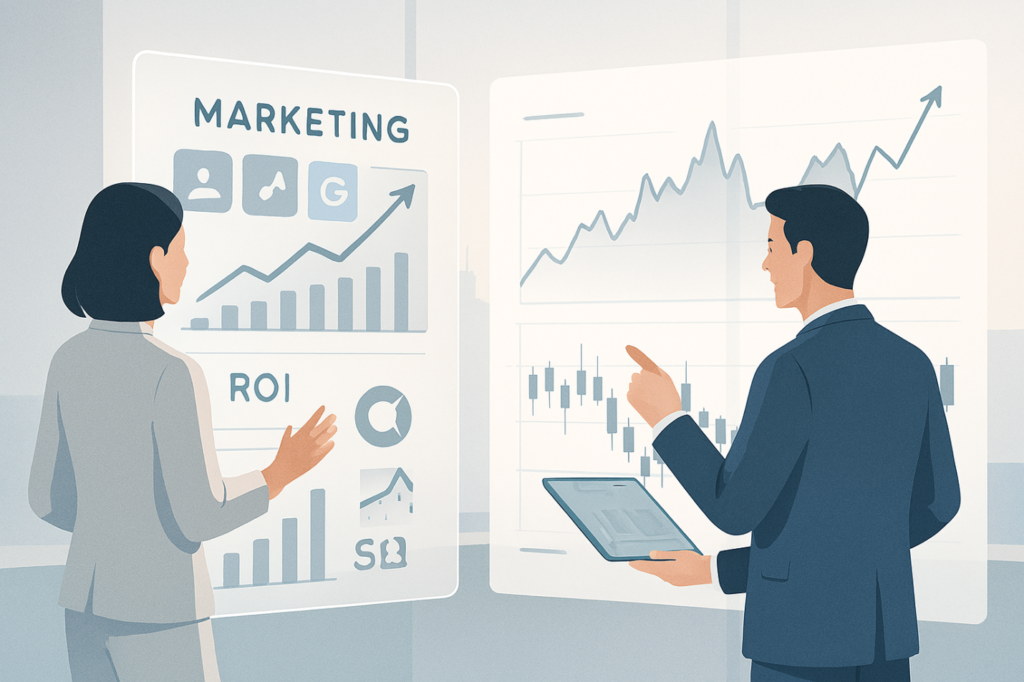
Marketing and financial markets are built on the same foundation: uncertainty managed through structure.
Both reward:
- Discipline
- Patience
- Continuous learning
Both punish:
- Emotional overreaction
- Blind optimism
- Shortcut-driven thinking
Independent Investor and similar platforms exist to remind traders that success comes from informed risk, not hype. Marketing benefits from embracing the same mindset.
When marketers stop chasing certainty and start managing probability, performance becomes calmer, more predictable, and ultimately more scalable.