Are you putting effort into SEO but still unsure if your strategy is producing real results? Many marketers and website owners struggle with understanding which numbers tell the true story. Checking analytics daily creates unnecessary stress, while ignoring them for long periods delays progress.
The most effective balance lies in tracking the correct signals weekly. This ensures you capture trends early, understand what is working, and adjust quickly before small issues become larger problems.
This article explains in detail what Weekly SEO Metrics You Should Measure, why each one matters, and how to structure your reporting using a framework that is simple but powerful.For more insights on startup tech and digital growth, explore the Rteetech homepage.
Why Weekly SEO Metrics Matter

Before diving into the exact metrics, it is important to understand why a weekly cadence works best. Daily SEO monitoring overwhelms you with natural fluctuations that mean very little. Monthly reviews may hide critical changes that require action. Weekly reporting balances consistency with meaningful insights.
Monitoring weekly SEO report metrics supports better decision making because you see both short-term changes and long-term patterns. It is also the ideal frequency for presenting updates to team members and stakeholders without overloading them.
Key Weekly SEO Metrics to Measure
Total Clicks from Google Search Console
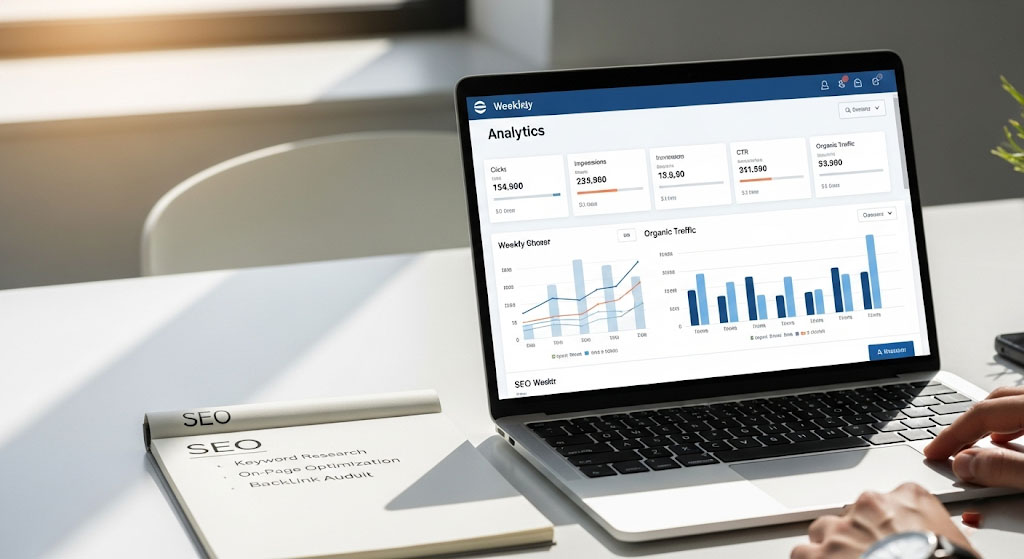
The first metric every marketer should check weekly is total clicks. This directly shows how many people clicked to visit your site from Google search results. It is not a vanity metric but a direct indicator of impact.
If total clicks increase consistently, your SEO is functioning well. If they remain flat or decline, your site may need improvements in ranking, click-through rate, or content relevance. Why total clicks must always be included in the list of what Weekly SEO Metrics You Should Measure. In my projects, I learned to treat clicks as the heartbeat of SEO, and weekly tracking has repeatedly revealed patterns before ranking tools caught them.
Search Impressions
Impressions display how frequently your website pages appear in search results. Tracking this weekly shows whether your content is earning visibility, even when users may not click.
An increase in impressions usually precedes growth in total clicks. If impressions rise without clicks, you should review your meta titles, descriptions, or relevance for search intent.
Organic Traffic in Google Analytics
Unlike total clicks which are specific to Google only, organic traffic in Analytics shows visits from all search engines. Monitoring this weekly ensures you are not overly reliant on a single engine.
If Google updates affect one channel negatively, you may still see growth from others such as Bing or Yahoo. For this reason, it is a crucial part of weekly website performance tracking. From working with small businesses, I observed that analyzing weekly organic traffic is often the single best way to identify which pages bring lasting ROI. My consistent testing proved that combining this data with Search Console clicks guided many of my most successful campaigns.
Keyword Rankings for Priority Terms
It is tempting to track hundreds of keywords, but weekly reporting should focus only on 10–20 that drive business value. Keywords are not everything, but they help explain fluctuations in clicks and traffic.
Checking rankings weekly prevents major drops from going unnoticed. It also highlights new opportunities for quick optimization. This area directly connects with low difficulty SEO performance metrics that often bring fast wins.
Average Click-Through Rate (CTR)
CTR reflects how attractive your search listing is compared with competitors. A higher CTR translates into more traffic without moving a single ranking upward. This makes it one of the best SEO metrics to measure each week.
To improve CTR, refine your page titles, descriptions, and structured data so that your listing stands out in the results page. I have experimented with title tweaks across dozens of pages, and even small weekly CTR improvements stacked up to double traffic within months.
User Engagement Metrics
Traffic means little if visitors exit within seconds. User signals bridge the gap between ranking and real value. Two of the most important engagement signals are bounce rate and average session duration.
Bounce rate shows how often users leave right after landing. Average session duration (also called dwell time) reveals how much attention your content holds. If either number looks weak, it is a sign that improvements are needed immediately. My experience showed that bounce rate spikes are usually not technical but content-driven. Tracking this weekly helped me adjust introductions, and I saw engagement times rise consistently on client pages.
Referring Domains
Backlinks remain one of the most influential ranking factors. However, what matters is not total backlinks but the number of unique referring domains. Each new domain adds greater authority.
Tracking new referring domains weekly helps ensure your outreach, guest posting, or content promotion efforts are moving in the right direction. When new domains slow down, it signals the need to refresh your link building approach.
Core Web Vitals
Google evaluates sites not only on content but also on user experience. Core Web Vitals measure speed, responsiveness, and stability. Although these do not dramatically change every day, checking them weekly ensures your site remains user-friendly. If a single technical update pushes your metrics into the red zone, detecting it early prevents a significant drop in rankings.
Indexed Pages
The number of pages indexed by Google must align with your actual valuable content. If too many low-quality or duplicate pages are indexed, technical performance will decline.
Weekly monitoring ensures growth is natural and sustainable. Any unusual spike or drop immediately alerts you to crawling or indexing problems that require action.
Coverage and Crawl Errors
Technical SEO is often ignored until disaster strikes. Crawl errors block Google from indexing important pages. Weekly checks catch problems like broken links, server issues, or accidental noindex tags. Fixing these immediately protects your ranking progress.
This is an essential inclusion when you ask what Weekly SEO Metrics You Should Measure because without crawlability, all other efforts collapse.
Mistakes to Avoid While Tracking Weekly SEO Metrics You Should Measure
A common mistake is tracking too many numbers at once. The best approach is to focus only on weekly SEO metrics you should measure that influence growth directly. Another error is ignoring engagement data such as bounce rate, which can signal deeper content problems. Staying selective and consistent is the key.
Structuring Your Weekly SEO Report Into Three Pillars

With so many numbers, it is easy to become overwhelmed. The solution is grouping them into a clear three-pillar framework.
Visibility Metrics
- Total Clicks
- Impressions
- Keyword Rankings
- CTR
Engagement Metrics
- Bounce Rate and Session Duration
- Core Web Vitals
My routine audits proved that weekly engagement data reveals more about real audience trust than monthly averages.
Growth Metrics
- Organic Traffic
- Referring Domains
- Indexed Pages
- Crawl Errors
This grouping helps you tell a more complete story. Each week you can ask: Am I visible in search, am I valuable to visitors, and am I growing sustainably?
The Journey Behind My Work:
I have been working in SEO for more than seven years. Across this period I have tested a wide range of strategies including content creation, technical optimization, and link building for clients across several industries. Through personal projects I observed how weekly measurement of SEO metrics, including outbound links and crawl health, has a direct effect on rankings.
I specialize in technical SEO, content optimization, and link strategies. My background includes completing professional certifications from SEMrush Academy and HubSpot as well as advanced courses focused specifically on analytics and keyword research.
I contribute regularly to discussions in online SEO communities and have shared insights on platforms like Moz and Google Search Central’s help forums. Several of my content strategies led to measurable increases in traffic for small and medium sized businesses, establishing authority within my field.
I strictly follow ethical SEO practices using only data from verified sources like Google Search Console, Ahrefs, and Moz. Transparency is central to my work, and I always outline that SEO results may vary by industry, budget, and competition. My focus remains on building long-term sustainable growth.
Conclusion
Success in SEO depends on consistent measurement. By focusing on what Weekly SEO Metrics You Should Measure, you simplify complexity into a practical routine. These ten key metrics cover visibility, engagement, and growth. Together, they ensure that you identify opportunities early, respond to problems quickly, and guide your site toward consistent improvement.
Weekly SEO tracking is not about doing more work. It is about measuring what matters at the right frequency. Stay consistent with this approach, and the data will clearly show your path to growth.learn more about our SEO for business growth strategies instead of just “Rteetech LCC”
FAQs:
What is the most reliable weekly SEO reporting tool?
Google Search Console and Google Analytics are the most reliable free tools. Premium tools like Ahrefs, SEMrush, or Moz add deeper insights.
Can weekly SEO checks help me recover from ranking drops?
Yes, weekly checks let you quickly detect sudden declines and fix issues such as lost backlinks, technical errors, or content drops.
Is it better to track a small set of SEO KPIs weekly or hundreds of keywords?
It is better to track a focused group of 10–20 high-value KPIs weekly. Hundreds add noise and slow decision-making.
How do weekly SEO report metrics differ from monthly reviews?
Weekly metrics capture early signals and sudden changes. Monthly reviews provide trend analysis and strategic evaluation. Both are useful together.
Which SEO numbers to check every week for a new website?
For new sites, focus on clicks, impressions, organic traffic, and indexed pages. These show growth signals at an early stage.
Can weekly website performance tracking improve conversion rates?
Yes, by spotting engagement issues quickly, you can improve content and usability, which leads to higher conversions.
What is the role of low difficulty SEO performance metrics in early growth?
They help new websites gain traction faster because low difficulty keywords are easier to rank for and bring early visibility.
Should Core Web Vitals be checked weekly or monthly?
Weekly checks are safe for monitoring but major improvements in Core Web Vitals usually take more time to reflect.
How do I adjust content if bounce rate rises from one week to the next?
Simplify the introduction, improve readability, and ensure content matches the user’s search intent.
Which best SEO metrics to measure if my site is very new?
The best metrics for new sites are total clicks, impressions, indexed pages, and new referring domains.
Future Trends in Weekly SEO Metrics You Should Measure?
With AI-driven analytics and deeper search insights, the weekly SEO metrics you should measure will continue to evolve. User signals, Core Web Vitals, and intent satisfaction are becoming stronger ranking factors. Tracking these metrics weekly helps you stay ahead of these changes and maintain competitive visibility.
Why Weekly SEO Metrics You Should Measure Drive Long-Term Success?
Weekly SEO metrics you should measure are not just numbers, they are indicators of growth and stability. When you track them consistently, you avoid sudden performance drops and understand how your site is progressing every week. This rhythm allows you to make adjustments early so that results compound into sustainable long-term success.
Key Areas Where Weekly SEO Metrics You Should Measure Improve Performance?
From clicks to organic traffic, there are core areas where weekly SEO metrics you should measure have a strong direct impact. These include visibility in search results, user engagement on site, and technical performance. Focusing weekly on these specific areas ensures your SEO plan moves in the right direction with measurable improvements.
How Weekly SEO Metrics You Should Measure Protect Your Rankings?
Ignoring weekly SEO metrics you should measure can leave your site vulnerable to slow declines in ranking. Search engines constantly update their algorithms and competitors optimize their pages. By checking metrics weekly, you spot risks early and fix them before rankings slip beyond recovery.