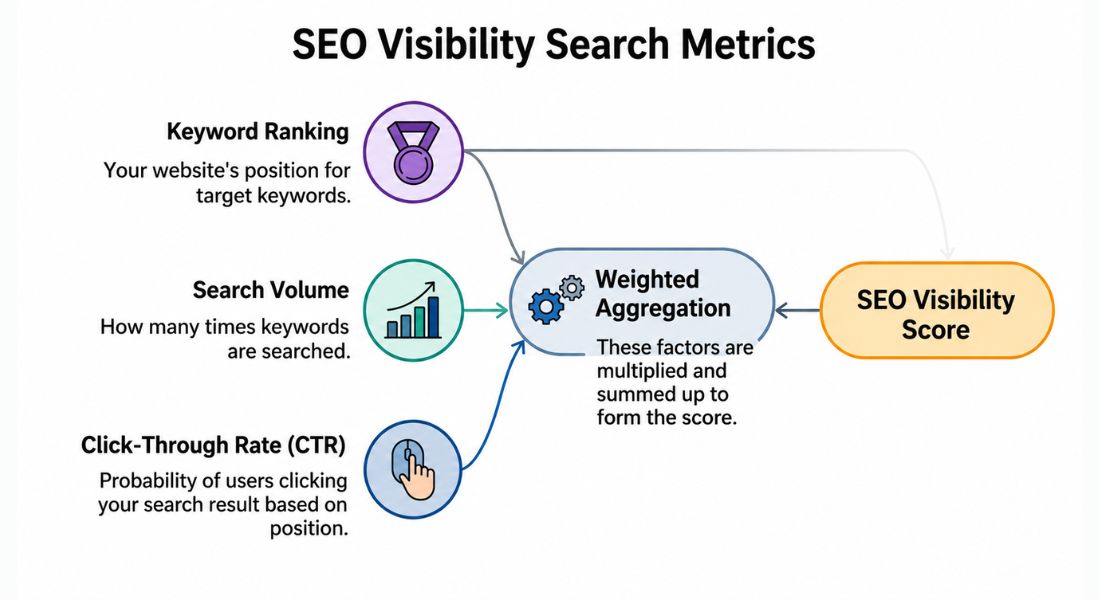
SEO visibility search metrics measure how much of the total organic click opportunity your website actually captures across tracked keywords not just where you rank.
Unlike rankings, visibility weights every position by real search volume and CTR giving you a far more honest picture of your organic search presence. Read this guide to understand how visibility is calculated, what drives it and how AI search is changing the measurement game entirely.
What Is SEO Visibility and Why Does It Matter?
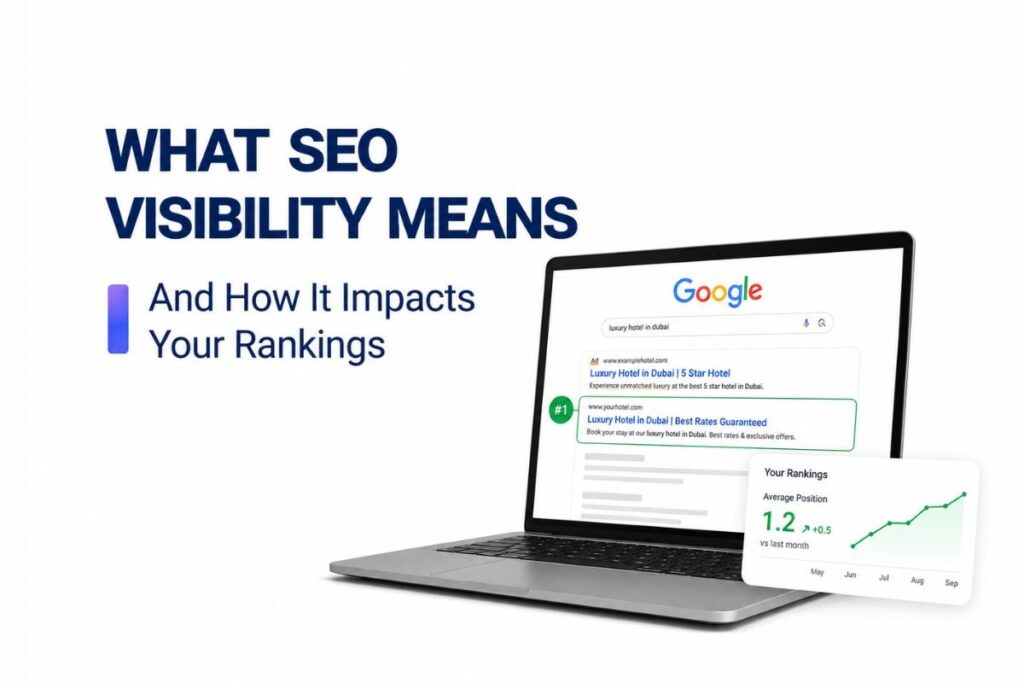
SEO visibility is an index-based metric that estimates the percentage of potential organic clicks your website captures across a defined set of tracked keywords. It runs from 0% meaning you rank for none of your tracked terms to 100%, which represents holding the top position for every keyword in your set.
Platforms like Semrush, Moz, SISTRIX and Searchmetrics each calculate and express this differently, but the core idea is the same across all of them. The reason this metric matters more than a rank report is that it builds commercial context into the measurement.
Two websites can rank for the exact same keywords and carry completely different visibility scores because one holds top positions on high-volume queries while the other holds low positions on terms nobody searches. Raw ranking data hides that difference entirely. Visibility scoring exposes it clearly.
How Does It Differ from Organic Traffic?
Organic traffic counts actual visits. Visibility estimates potential opportunity. A site can have decent traffic and a genuinely low visibility score usually because traffic comes from branded queries the site already dominates while unbranded commercial terms are invisible to new customers.
Conversely, a rising visibility score often precedes a traffic increase by several weeks, which is exactly why experienced SEO practitioners treat it as a leading indicator rather than a lagging confirmation of past work. It warns you early instead of confirming problems late.
How Is the Visibility Score Actually Calculated?
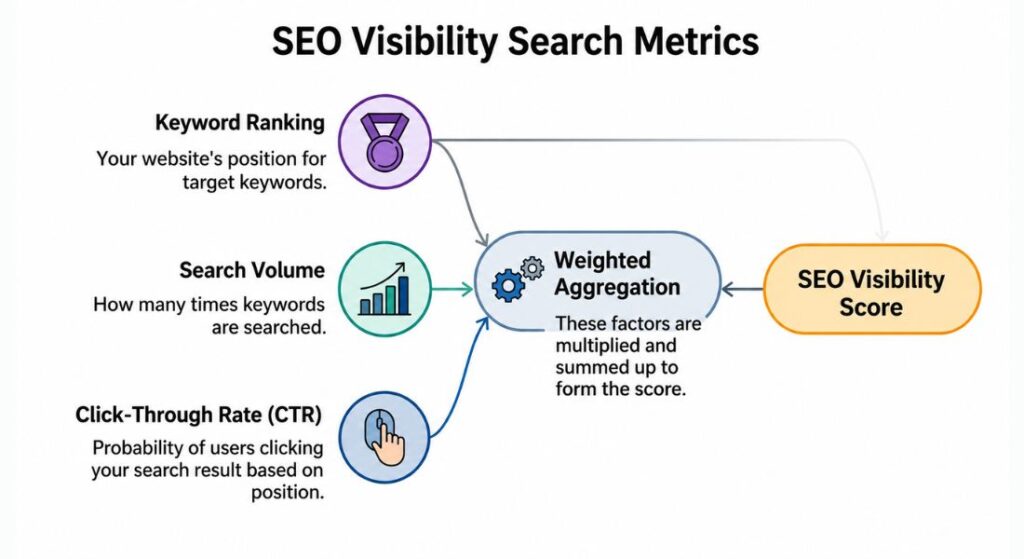
The formula behind every visibility tool follows the same basic logic. The platform takes your ranking position for each tracked keyword, applies a click-through rate estimate for that position, multiplies it by the keyword’s average monthly search volume, then adds all those weighted values together.
It divides by the theoretical maximum what you would capture ranking first for everything to produce a normalized percentage score. That weighting is what separates visibility from anything simpler. Position one captures roughly 28 to 32% of clicks for a given query.
Position three captures around 10 to 13%. By position ten, you are looking at 1 to 2% CTR and that is before AI Overviews and featured snippets push organic results further down the page. Two sites ranking for the same keyword set can have dramatically different scores based purely on where those rankings sit.
Why CTR and Search Volume Weighting Changes Everything?
A keyword with 50,000 monthly searches contributes enormously more to your visibility score than a keyword with 200 monthly searches, even when you rank equally well for both. This is why building your tracked keyword set thoughtfully is one of the most important decisions you will make.
A set dominated by branded terms you already own makes your score look strong while hiding how invisible you actually are for commercial discovery terms your competitors control.
Your keyword set should include head terms, long-tail queries, commercial intent terms, and unbranded variations otherwise the metric confirms what you already know instead of challenging you to grow.
How Major SEO Tools Measure Visibility Differently?
There is no universal standard for this metric. Every platform uses its own keyword database, CTR model, and normalization method which is why the same website shows completely different numbers across tools. Understanding these differences helps you choose the right platform and interpret what you see correctly.
Semrush Visibility Percentage
Semrush calls its metric “Visibility %” and builds it inside its Position Tracking feature. You define the keyword set, and Semrush weights each ranking by its own aggregate CTR data for that position. A 100% score means you rank first for every tracked keyword.
A 50% score means you capture roughly half the possible visibility for your set. Its strength is intuitive interpretation and one of the most comprehensive commercial keyword databases available.
SISTRIX Visibility Index
SISTRIX produces a normalized index score rather than a percentage, calibrated against a reference baseline. This makes it especially powerful for long-term trend analysis and competitive benchmarking, particularly across European markets where it has the deepest keyword coverage.
You cannot translate a SISTRIX score directly to a traffic estimate, but comparing scores across time and competitors reveals competitive strength very clearly.
Moz and Other Platforms
Moz defines its visibility metric as the estimated percentage of clicks received from tracked keyword rankings and overlays known algorithm update markers including Google Panda and Penguin events directly on the trend graph.
This makes it easy to correlate score drops with specific Google core updates rather than spending days chasing an internal problem that was never the real cause.
Advanced Web Ranking and SEOmonitor calculate visibility as an impression share and both allow segmentation by device, which matters because Google’s mobile-first indexing means mobile and desktop scores regularly diverge in ways that reveal different optimization gaps.
Core Metrics to Track Alongside Your Visibility Score

Visibility gives you the clearest picture when you read it alongside a few supporting signals. Tracking it in isolation leaves diagnostic gaps that lead to wrong conclusions from otherwise good data.
Share of Voice – The Competitive Layer
Share of voice measures your visibility relative to competitors for the same keyword set. A visibility score of 35% is genuinely difficult to evaluate alone. Knowing your closest competitor holds 52% for the same keywords makes that 35% immediately meaningful.
Most rank tracking platforms let you run the same keyword set against multiple domains, turning a single-site metric into a real market benchmarking tool.
When your visibility holds steady but your share of voice falls, competitors are growing faster on the same terms. Stable visibility can feel like a win right until you add the competitive layer and realize you are losing ground.
SERP Features and CTR as Supporting Signals
Google Search Console gives you the most reliable first-party data on how pages actually perform. Rising impressions with flat CTR often point to a title tag or meta description problem, not a ranking problem.
Pairing Search Console data with your visibility score helps you distinguish between a positioning problem and a presentation problem, two issues that need completely different fixes.
Additionally, featured snippets, People Also Ask boxes and AI Overviews all capture user attention before standard organic results enter the picture.
Most traditional visibility calculators model ten blue links and miss SERP feature presence entirely, which is an increasingly significant blind spot as these features take more above-the-fold space.
Factors That Move Your Score Up or Down
Understanding what actually drives this metric helps you prioritize the right work instead of optimizing everything and measuring nothing clearly.
Topical Authority and Content Depth
Google’s ranking systems now evaluate how comprehensively a site covers a subject area, not just how well a single page targets one keyword. Building topical clusters, a strong pillar page supported by interconnected subpages covering every angle of the topic, signals depth of expertise that isolated pages cannot match.
Keyword cannibalization, where multiple pages on the same site compete for overlapping queries, splits ranking signals and directly undermines visibility.
Identifying and merging or differentiating those competing pages is one of the most reliable visibility improvements available without creating new content from scratch.
Technical SEO and Core Web Vitals
A strong content strategy sitting on weak technical infrastructure caps your visibility ceiling regardless of content quality. Core Web Vitals measuring loading performance, interactivity and visual stability are direct ranking signals that affect how Google scores the experience your pages deliver.
Poor scores suppress rankings on competitive queries, and ranking suppression shows up immediately as a visibility floor. Crawlability issues, incorrect canonical tags and index bloat all limit how many pages Google will rank strongly. Fixing these creates the clean foundation on which content-based visibility improvements can actually land and stick.
The AI Search Gap Traditional Visibility Cannot See
Here is what no traditional visibility score will tell you right now. The metric was designed for a click-based search world, and that world is changing fast.
Zero-click searches where users get a complete answer directly from the SERP without visiting any website now account for roughly 58 to 60% of all Google searches globally.
AI Overviews, featured snippets, and knowledge panels deliver answers without requiring a click. Your page can hold a strong ranking, show a healthy visibility score, and still receive fewer visits than historical CTR models predict.
Zero-Click Searches and What They Mean for Your Score
A visibility score built on pre-AI CTR curves now systematically overestimates the traffic those positions actually deliver. The score may look stable while organic sessions are flat-line.
Pairing your visibility score with Google Search Console real CTR data and watching for divergence between the two tells you whether SERP features are consuming what those ranking positions once delivered in actual visits. It is not a reason to abandon visibility scoring, it is a reason to read it more carefully alongside first-party data.
AI Citations and Answer Engine Visibility
A brand can rank well in traditional search and still be nearly invisible in AI-generated answers from ChatGPT, Perplexity, and Google AI Overviews. These systems favor pages that are semantically complete, clearly structured, and authoritative E-E-A-T signals matter significantly here.
Tools like Semrush’s AI Visibility Toolkit and Profound now track brand mentions, citations, and competitive AI presence specifically to cover this gap.
Forward-looking search measurement means monitoring both traditional SERP visibility and answer engine visibility together; neither tells the complete story of brand discoverability on its own.
Conclusion
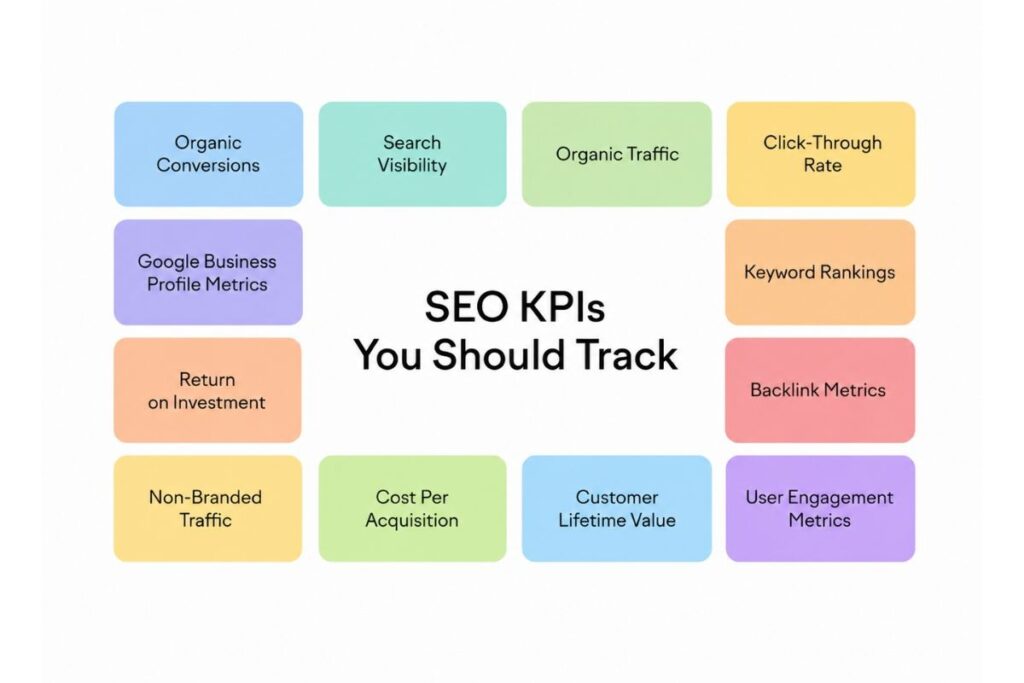
SEO visibility search metrics give you an honest, weighted measure of organic search performance that ranking reports never could. Build it on a representative keyword set, track the weekly trend, benchmark against direct competitors and pair it with Google Search Console data for real CTR context.
Add AI citation monitoring alongside it to account for the zero-click and AI answer layer that traditional models cannot yet see. Together, these give you the most complete and accurate picture of organic search presence available today.
Frequently Asked Questions
How is SEO visibility different from domain authority?
Domain authority predicts your ranking potential based on backlinks, while SEO visibility measures how much organic click opportunity you actually capture right now.
What is a realistic visibility score improvement timeline?
Expect meaningful visibility improvements within three to six months of consistent SEO work, with technical fixes showing faster results in four to eight weeks.
Does visibility score matter more than conversion rate for SEO reporting?
Visibility measures your reach in search; conversion rate measures what that reach delivers both matter and should be tracked together.
Can a newly launched website achieve a good visibility score quickly?
Yes, by targeting low-difficulty long-tail keywords and building topical depth in a focused niche from day one.
How does local SEO affect visibility score tracking?
Local searches trigger different SERP layouts, so track a location-specific keyword set separately for accurate local visibility measurement.