The academic landscape in 2026 is unrecognizable compared to just a few years ago. While Artificial Intelligence has become a ubiquitous companion for brainstorming and data sorting, a curious trend has emerged: the highest graded papers and the most cited research projects are overwhelmingly those that prioritize human ld strategy over automated generation.
For undergraduate students navigating this tech heavy era understanding why “human in the loop” systems win is the secret to academic longevity and professional readiness. The primary reason for this shift is the “Context Gap.”
AI, for all its processing power, operates on probability, not intent. It can predict the next likely word in a sentence, but it cannot understand the specific nuances of a professor’s grading rubric or the subtle cultural implications of a sociological study.
When students seek comprehensive assignment help, they aren’t just looking for words on a page; they are looking for the application of logic, the verification of facts and the strategic alignment of arguments that an algorithm often misses. This human oversight ensures that the work isn’t just “correct” by a software standard but meaningful by an academic one.
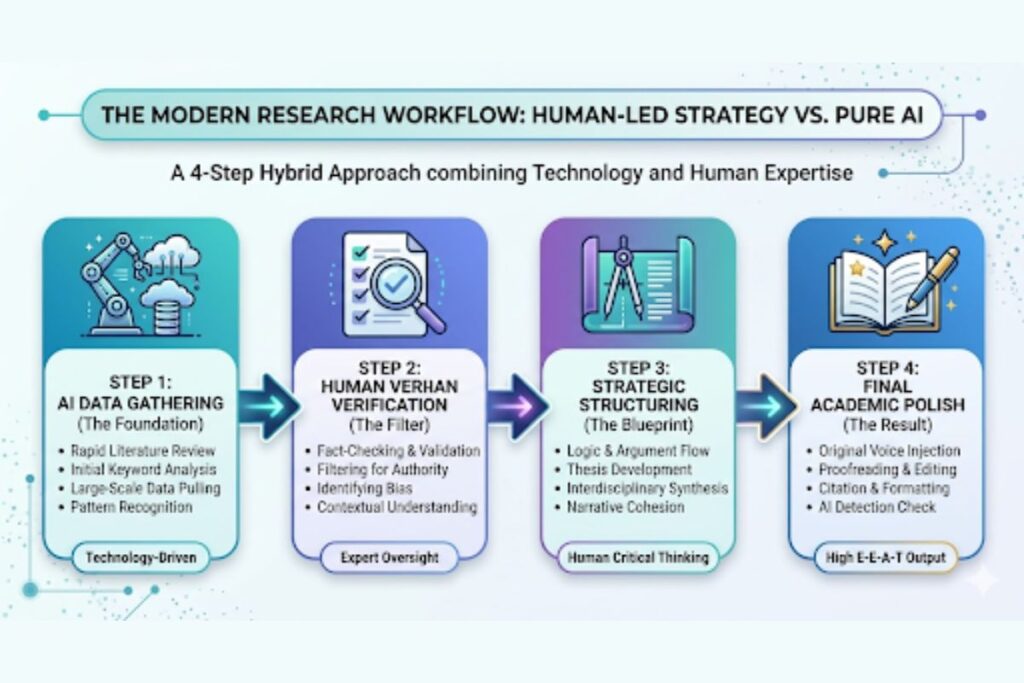
The Evolution of Research: From Search Engines to Synthesis!
In the early 2020s, research was about finding information. In 2026, research is about synthesizing it. With the explosion of AI generated “noise” on the internet, the challenge for students is no longer finding data it is verifying it.
Pure AI tends to hallucinate or rely on outdated datasets, leading to citations that don’t exist or theories that have been debunked. Human led strategy involves “Information Gain.”
This is a concept where a writer adds new value, personal insight, or unique connections that don’t already exist in the training data of a machine. For an undergraduate, this means moving beyond summarizing Wikipedia and instead connecting classroom theories to real world events happening right now.
Why Quality Metrics Have Changed
Search engines and university plagiarism checkers have evolved simultaneously. They no longer just look for “matched text”; they look for “semantic patterns.” AI generated content often follows a predictable rhythm that triggers red flags.
Human writing, however, is beautifully inconsistent. It features varying sentence lengths, unique metaphors, and a personal “voice” that builds trust with the reader.
| Feature | Pure AI Generation | Human-Led Strategy |
| Fact Accuracy | Prone to “hallucinations” | Verified by subject experts |
| Depth of Logic | Surface-level summaries | Deep, interdisciplinary links |
| Tone & Voice | Robotic and repetitive | Engaging and relatable |
| Search Ranking | Flagged as “Low Value” | Ranked as “Helpful Content” |
| Academic Integrity | High risk of policy breach | High level of original thought |
The Critical Role of Structured Writing
Writing is more than just an end product; it is a way of thinking. When you outsource your entire thought process to a machine, you lose the ability to defend your thesis during an oral exam or a class discussion. This is why many top performing students use hybrid models.
They might use tech to organize their schedule, but they turn to essay help online from MyAssignmentHelp experts to understand how to structure a narrative that flows logically. Having an expert guide you through the “why” of a paragraph’s structure is a form of active learning that no chatbot can replicate.
Avoiding the “Generic” Trap
If every student uses the same AI prompts, every student produces the same average work. This “homogenization” of content is a major red flag for educators. To stand out, you need to inject “Experience” into your writing one of the core pillars of Google’s E-E-A-T guidelines.
Share a brief anecdote about a lab experiment that went wrong, or link a historical event to a modern digital trend. These small, human touches act as a “proof of work” that proves a person was behind the keyboard.
Strategic Content Framework for 2026
To ensure your academic blog or guest post ranks on the first page of Google today, you must follow the “Helpful Content” protocol. This means writing for the user first and the search engine second.
- The Specificity Rule: Use specific names, dates, and locations.
- The Problem-Solution Loop: Every paragraph should identify a student struggle and provide a tangible way to fix it.
- Visual Literacy: Don’t just write; describe. Use tables, bullet points, and short sentences to keep the reader’s eye moving down the page.
The Future of Academic Integrity
As we move further into 2026, the definition of “originality” is changing. It is no longer about not using tools; it is about how you oversee those tools. The most successful undergraduates are those who act as “Editors-in-Chief” of their own education. They use technology to gather raw materials but use human expertise to build the final structure. This ensures that their work remains authoritative, trustworthy, and, most importantly, human.