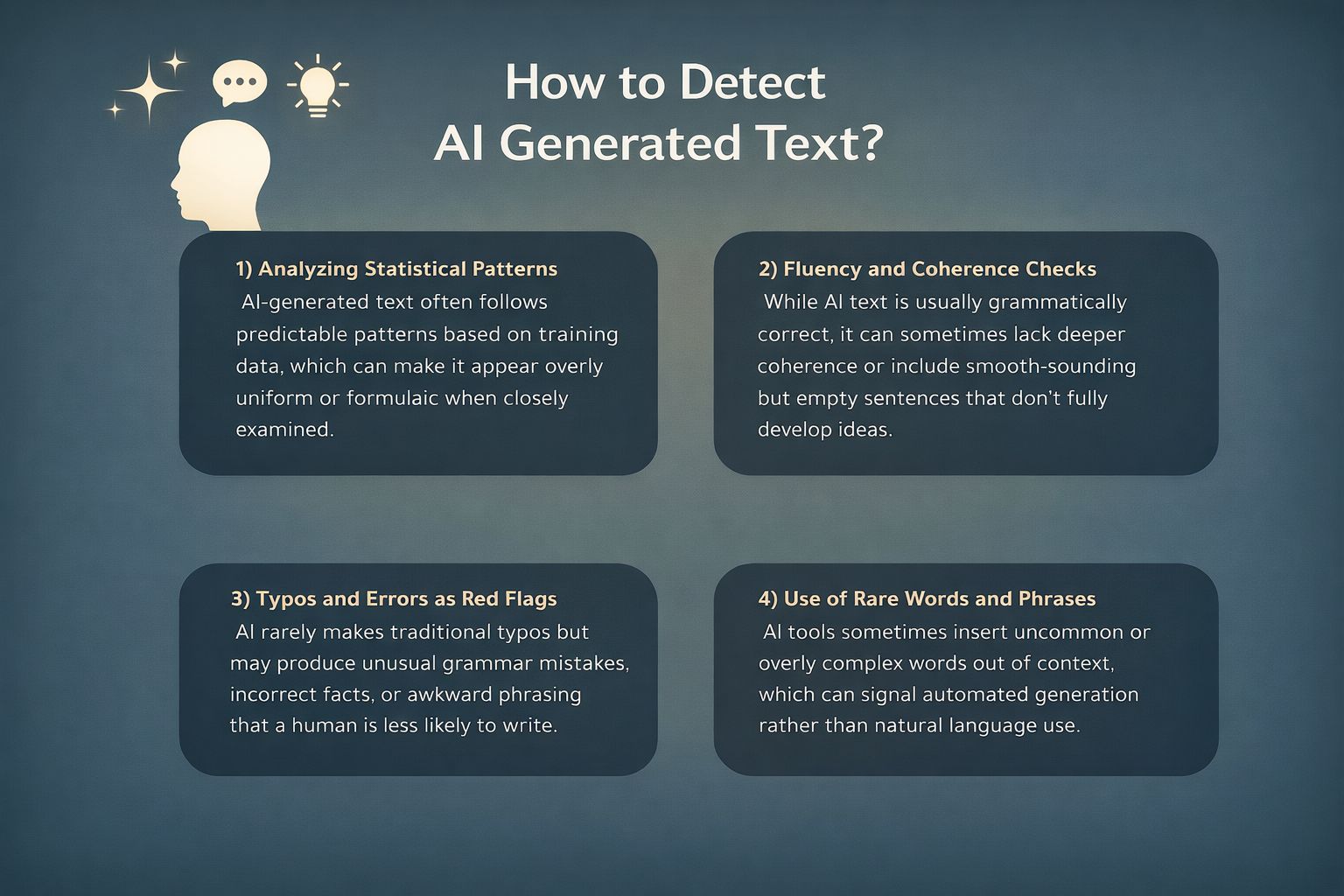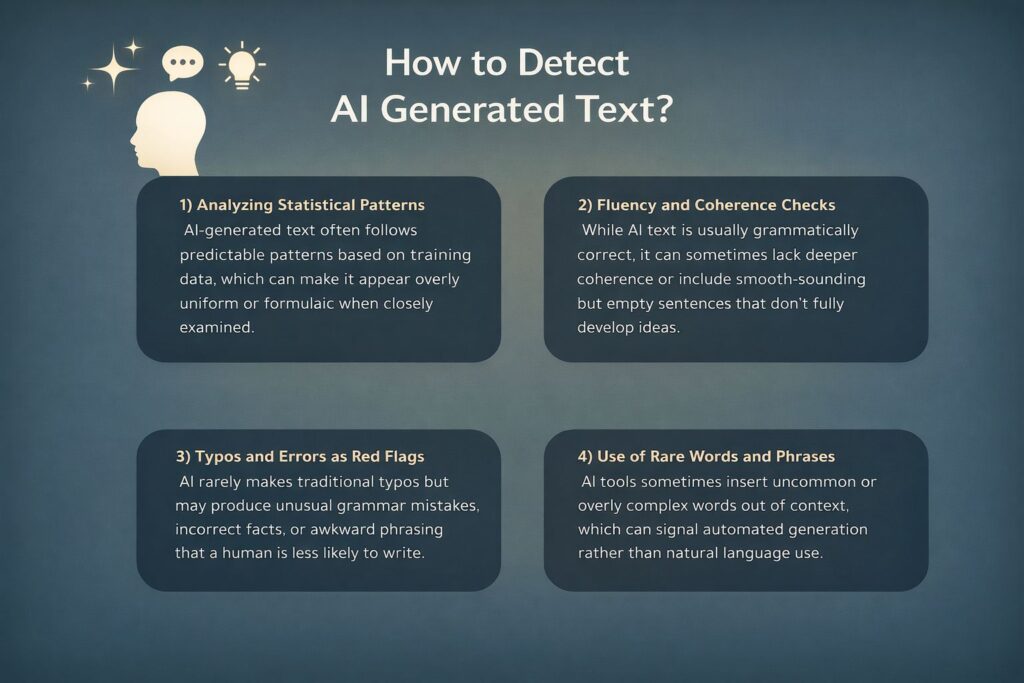
Artificial intelligence is transforming the way we create and consume content. Tools like ChatGPT, GPT-4 and other large language models can generate essays, articles and creative writing in seconds. While this technology is impressive it raises a critical question: how can you tell if a piece of text was written by AI or by a human?
Whether you are a teacher checking homework, a business reviewing content or a curious reader, understanding the signs of AI-generated text is essential to maintain accuracy, credibility and trust.
What is AI-Generated Text?
AI-generated text is content produced by machine learning models rather than humans. These models, particularly large language models, predict the next word in a sentence based on patterns from vast amounts of training data.
This predictive process allows AI to generate coherent paragraphs almost instantly which makes it appear very human-like at first glance. However AI lacks lived experience, personal knowledge and cultural context.
While the text may be grammatically correct and coherent it often misses subtleties like idiomatic expressions, emotional resonance or complex reasoning that humans naturally inject.
AI also tends to generalize or simplify complex ideas producing content that may seem polished but is shallow in insight. Understanding these limitations is key to spotting AI content in any context from educational assignments to marketing materials.
How AI Writing Works (LLMs & Token Prediction)?
Large language models like GPT-4 generate text using token prediction where each token represents a word part of a word or punctuation. The model calculates probabilities for which token should come next based on prior context creating sentences one piece at a time. While this allows rapid and coherent text generation it also introduces patterns that differ from human writing.
For example AI may overuse certain connectors to produce highly structured paragraphs or repeat ideas in slightly different wording. Another challenge is hallucinations where AI confidently states information that is factually incorrect or unverifiable.
Recognizing the mechanisms behind AI writing helps in identifying subtle signals such as overly consistent sentence lengths, lack of idiomatic expressions and a uniform tone that humans rarely maintain across long texts.
Additionally AI models can produce a “neutral” style that avoids strong opinions or emotional cues unless specifically instructed. This absence of a personal voice or authentic perspective is often a giveaway when reviewing essays, blog posts or product descriptions.
Being aware of how token prediction drives AI generation gives readers and reviewers a framework to assess text critically.
Why is AI Text Different from Human Writing?
Humans write with intent personality and depth drawing from personal experiences, emotions and cultural context. Human writing is often nonlinear with sentences that vary in length and complexity, occasional digressions and subtle humor or irony.
AI-generated text tends to follow predictable patterns sticking closely to general structure repeating key ideas or using common phrasing. It rarely incorporates anecdotes, nuanced opinions or ethical reasoning unless specifically prompted.
Another difference lies in context comprehension. Humans can reference previous events, cross-link ideas and provide commentary that reflects understanding of a broader situation. AI models on the other hand operate purely on probabilities and trained patterns.
This sometimes leads to contradictions or statements that feel “off” when considered in a real world context. By comparing text for these qualities personality depth, consistency and contextual understanding readers can often detect whether AI contributed to the writing.
Why Detecting AI Text Matters?
Detecting AI-generated content has real-world importance beyond curiosity. In academic and professional settings educators and institutions need to ensure that student work is original. AI-generated content can provide shortcuts for students or employees which may undermine assessment integrity or workplace authenticity.
Businesses and content creators require authentic material to maintain credibility, protect brand reputation and deliver real value to their audience. Moreover AI content can unintentionally propagate misinformation or exaggerate facts.
Identifying AI-generated content helps prevent the spread of misleading narratives, ensures transparency and maintains ethical standards. In industries like journalism law or healthcare the inability to distinguish AI-generated content could result in legal issues or reputational damage.
Detecting AI text empowers readers, educators and professionals to maintain trust and make informed decisions about the material they encounter.
Common Signs of AI-Generated Text
Even advanced AI models leave subtle clues. AI writing often exhibits repetitive patterns in sentence structures where multiple sentences start similarly or reuse phrases unnecessarily. Content may feel generic summarizing information without including anecdotes, opinions or specific examples that make it uniquely human.
Perfect grammar is another indicator; AI rarely breaks rules intentionally for effect whereas humans often vary punctuation and sentence construction to emphasize points or inject personality.
Other signs include contextual misalignment or factual errors. AI may mention events or statistics that are slightly inaccurate or irrelevant to the topic. It may also overuse common phrases, buzzwords or generalized statements.
Recognizing these patterns requires careful reading, attention to flow and a comparison of the text against human written standards. The more you practice evaluating these signals the easier it becomes to spot AI contributions even in well crafted paragraphs.
Manual Techniques to Identify AI Text
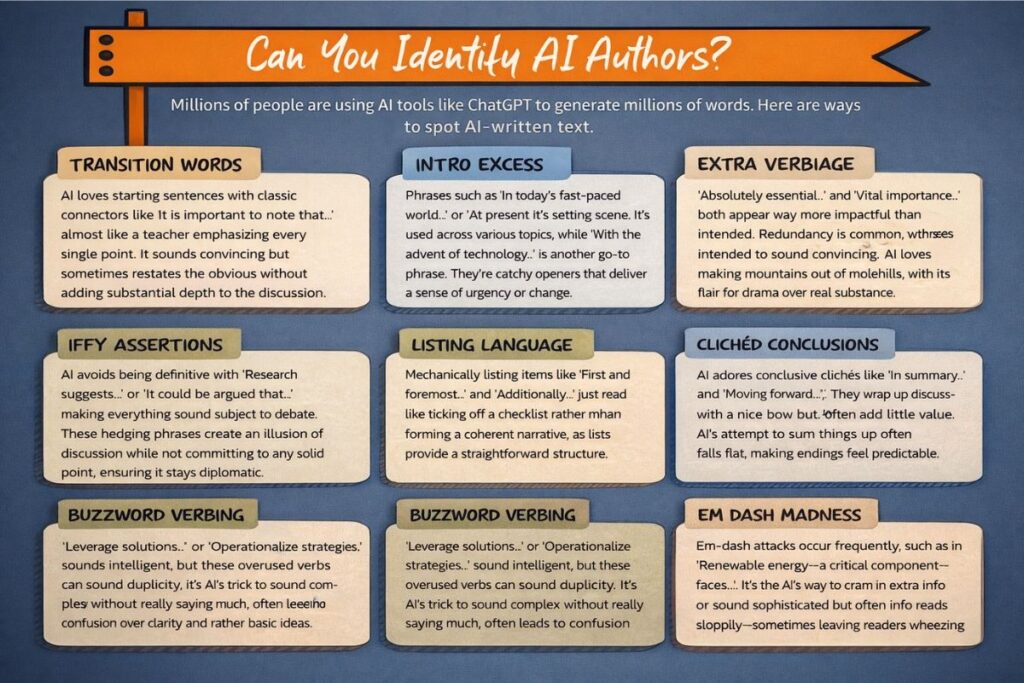
Manual examination can reveal AI-generated writing without relying solely on software tools. Start by reading for style flow and coherence. AI may abruptly switch topics, maintain a monotonous tone or repeat information unnecessarily.
Observing sentence rhythm and paragraph transitions often reveals mechanical patterns unique to machine writing. Next check for personalization and real experiences. Humans naturally include references to personal life, cultural observations or subjective opinions which AI struggles to generate authentically.
Comparing suspicious content to previous work by the same author is also effective as AI typically produces neutral impersonal text that contrasts with an individual’s established voice.
By combining careful reading, contextual analysis and attention to narrative depth it is possible to detect AI-generated text with reasonable confidence.
AI Detection Tools
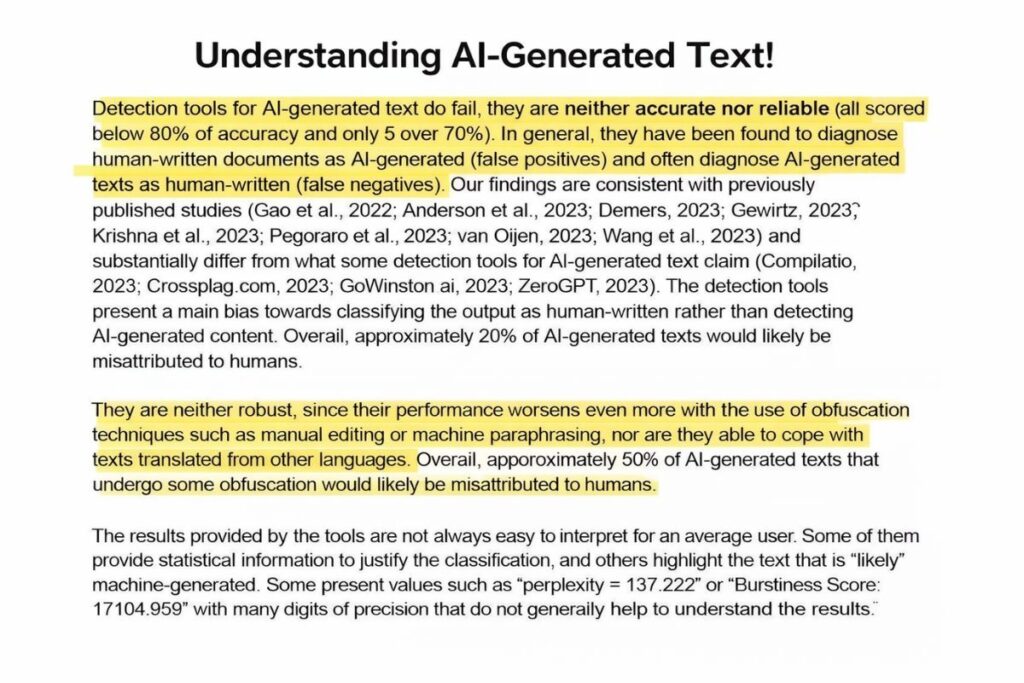
AI content detectors can help supplement manual analysis though they are not infallible. These tools evaluate text for statistical patterns measuring aspects like perplexity which assesses predictability and burstiness which gauges sentence variation.
Text with low burstiness and high predictability is more likely to be AI generated. However detectors can misclassify structured human writing academic papers or technical documentation as AI due to uniformity.
Tools such as GPTZero Originality.ai Copyleaks AI Detector and Turnitin AI Writing Detector are commonly used and provide initial insights.
For best results it is recommended to use multiple tools alongside manual evaluation. This combined approach allows reviewers to account for the subtleties of style context and factual accuracy while mitigating false positives.
Human vs AI Writing: Key Differences!
Human writing naturally varies in sentence length, tone and complexity creating a dynamic rhythm that engages readers. Humor cultural references and ethical reasoning appear naturally in human text whereas AI-generated content often maintains a flat neutral tone.
Humans develop distinctive voices over time making their writing identifiable by style, perspective and personal nuance.
AI content even if coherent and grammatically perfect tends to be generic and may feel repetitive across different topics. Awareness of these differences provides a practical framework for differentiating between human and AI authorship.
Limitations and Challenges in AI Text Detection
Detecting AI-generated content is becoming increasingly challenging as models improve in sophistication. Advanced AI can mimic human style, inject contextually appropriate phrases and produce content that closely resembles human writing.
Even experienced reviewers may struggle to identify AI without additional context or tools. Detection becomes more complicated when AI and human writing are combined within a single document as subtle human insights may mask AI-generated segments.
Understanding these limitations encourages cautious evaluation and highlights the need for multiple detection methods including both manual review and technological assistance.
Practical Examples: Spotting AI in Real Texts!
Practical examples illustrate how AI writing can manifest in different contexts. In student essays AI contributions often show repetitive phrasing, generic explanations and overuse of connectors lacking real world examples or subjective insights.
Marketing content may include buzzwords or industry jargon excessively presenting a professional tone without tangible knowledge of the subject. News articles may lack context, misstate facts or omit local or cultural nuance that a human reporter would naturally include.
Cross-referencing content with verified sources and previously published human work enhances detection accuracy and confirms AI involvement when patterns emerge.
Best Practices for Identifying AI Text
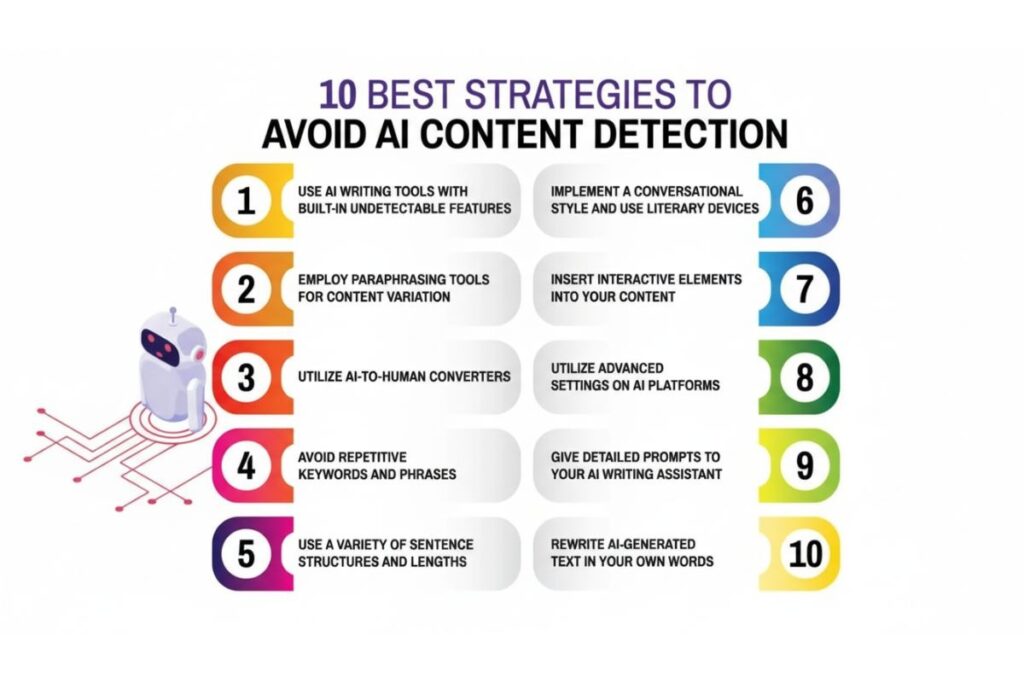
Effective AI detection combines multiple strategies. Manual reading allows detection of stylistic inconsistencies, factual errors and narrative gaps. Fact checking confirms whether statements are accurate and contextually relevant.
Observing personal anecdotes, opinions and human insights provides a strong contrast to machine-generated neutrality. Comparing text against prior samples from the same author helps reveal deviations in style, tone and voice.
Staying informed about new AI models, their capabilities and updated detection methods ensures ongoing proficiency in evaluating content allowing readers and professionals to maintain credibility and authenticity in their work.
Conclusion:
AI-generated text is now widespread but it is not impossible to detect. Paying attention to patterns, personal touches and context while using AI detection tools thoughtfully allows for accurate identification. Combining human judgment with technology helps maintain authenticity, credibility and ethical standards online.
By understanding the signs limitations and practical techniques for detection you can confidently evaluate any content you encounter and ensure it meets the standards of truth and originality.
FAQs
Can AI-generated text be legally considered plagiarism?
AI-generated text itself is not automatically plagiarism but using it without disclosure in academic or professional settings can violate copyright or ethical standards. Institutions may treat undisclosed AI-assisted work as misrepresentation so it’s important to cite AI contributions when required.
How does AI text affect SEO and website ranking?
Search engines prioritize original high quality content. AI-generated content without value or uniqueness may harm SEO rankings. Websites relying solely on AI text risk being flagged for low originality duplicate content or poor user engagement even if the grammar is perfect.
Are there AI detection methods for multilingual content?
Detecting AI-generated text in non English languages is more challenging. Many AI detectors are optimized for English so tools may be less accurate in other languages. Manual evaluation, cultural context and cross-referencing with local sources become crucial for multilingual content detection.
Can AI text mimic specific author styles?
Advanced AI models can imitate the writing style of a particular author if provided with enough sample text. This makes detection harder as AI can reproduce tone vocabulary and sentence structure though subtle nuances and real life experiences often still reveal differences.