Technology has reshaped how we work, communicate, and manage our time. Smart devices, automation tools, and digital workflows are now deeply embedded in daily life. Yet many households still struggle with one fundamental challenge: maintaining an efficient, clutter-free living environment that supports productivity instead of draining energy.
Efficiency at home is not only about having the latest gadgets. It is about systems, routines, and consistency. Just as technology teams rely on structured processes to keep platforms running smoothly, modern households benefit from predictable routines that prevent small issues from turning into daily stressors.
A clean and organised home plays a much larger role in this system than many people realise.
Why efficiency starts at home, not on a screen
Remote work, flexible schedules, and hybrid lifestyles have blurred the line between home and workplace. Living spaces now function as offices, study areas, relaxation zones, and family hubs all at once. When these spaces become disorganised, the mental load increases.
Research into productivity consistently shows that clutter competes for attention. Visual noise makes it harder to focus, increases fatigue, and slows decision-making. In a world where people already juggle multiple digital inputs, an untidy environment adds unnecessary friction.
Technology can help manage tasks, but it cannot compensate for an inefficient physical space. That is why smart households focus on foundational routines before layering on advanced tools.
Systems thinking applied to everyday living
In technology, systems thinking means understanding how small components interact over time. A neglected update today becomes a critical failure tomorrow. Homes operate in the same way.
Dust accumulation, cluttered surfaces, and overlooked maintenance tasks rarely cause immediate problems. Instead, they compound quietly. When cleaning is postponed repeatedly, it eventually requires more time, more effort, and more disruption.
Efficient homes apply the same logic used in system maintenance:
- Break tasks into manageable cycles
- Address issues before they escalate
- Keep workflows predictable
This is where routine matters more than intensity.
Why routines outperform one-off efforts
Many households rely on occasional deep cleaning sessions. While these can restore order temporarily, they are inefficient in the long run. Large cleaning sessions consume entire weekends and often lead to burnout. Afterward, routines slip again, restarting the cycle.
Weekly routines, on the other hand, function like scheduled system checks. They keep the environment stable without overwhelming effort. Floors stay manageable, surfaces remain clear, and hidden problem areas are addressed regularly.
From a productivity perspective, routine cleaning reduces cognitive load. People spend less time deciding when to clean and more time focusing on work, family, or rest. The predictability itself becomes a form of optimisation.
Delegation as a smart system upgrade
In technology teams, not every task is handled in-house. Specialised functions are outsourced when it makes sense. The same principle applies at home.
As work hours extend and personal schedules become more demanding, many households treat cleaning as a system component rather than a personal chore. Delegating routine maintenance allows residents to focus on higher-value activities without sacrificing environmental quality.
This is why some households integrate external support such as SG House Cleaning services into their overall home management strategy. The decision is not about convenience alone. It is about system reliability.
When cleaning becomes predictable and structured, it stops interrupting daily workflows.
Preventive maintenance and long-term efficiency
In software development, preventive maintenance reduces the risk of costly failures. Regular updates and monitoring prevent breakdowns that require emergency fixes later. Homes follow the same logic.
Weekly cleaning prevents:
- Dust build-up that affects air quality
- Stains that become harder to remove
- Clutter that slowly consumes usable space
By addressing these issues early, households avoid large disruptions later. This is especially important in homes with children, pets, or work-from-home setups where cleanliness directly impacts health and focus.
A weekly home cleaning service functions much like scheduled system maintenance. It keeps baseline conditions stable so residents do not need to react to problems after they escalate.
Smart homes need smart habits
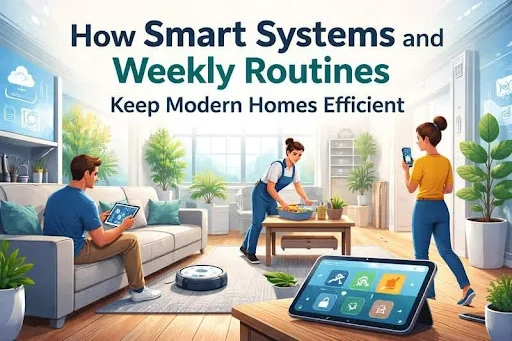
Smart thermostats, robotic vacuums, and app-controlled lighting are useful tools, but they do not replace habits. Technology amplifies routines. It does not create them.
Households that rely solely on devices without consistent habits often feel disappointed. The tools exist, but the environment still feels chaotic. This happens because automation works best within structured systems.
For example, a robotic vacuum performs optimally in a clutter-free space. If floors are consistently blocked by scattered items, the technology becomes ineffective. Routine cleaning ensures that smart tools deliver their intended value.
The hidden cost of inefficiency at home
When homes lack structure, inefficiency shows up in subtle ways. Time is lost searching for items. Concentration breaks frequently. Small frustrations accumulate throughout the day.
These costs are rarely measured, but they impact performance and well-being. Over time, inefficient home environments contribute to burnout, reduced productivity, and decision fatigue.
By contrast, structured routines create psychological safety. People know what to expect. Tasks are handled before they become urgent. The home supports daily goals instead of competing with them.
Routine cleaning and mental bandwidth
Mental bandwidth is limited. Every unresolved task occupies space in the mind. This includes visible clutter and unfinished chores.
Weekly routines free mental bandwidth by eliminating constant reminders. When cleaning is scheduled and handled consistently, it no longer demands attention. This allows households to redirect focus toward work, creativity, or rest.
In technology, reducing background processes improves system performance. At home, reducing background stressors improves quality of life.
Efficiency for families and shared households
Efficiency becomes even more important in shared living environments. Families, roommates, and multi-generation households all benefit from predictable systems.
When cleaning responsibilities are unclear or inconsistent, friction increases. Misaligned expectations lead to conflict. Structured routines remove ambiguity.
Weekly cleaning schedules create shared understanding. Everyone knows the baseline standard. This reduces tension and makes daily cooperation easier.
For households with children, consistency also builds habits early. Children learn that maintenance is part of daily life, not a crisis response.
Why consistency matters more than perfection
Efficiency does not require perfection. It requires consistency.
A home does not need to look flawless at all times. It needs to function well. Regular upkeep ensures that imperfections remain small and manageable.
This mindset mirrors agile development. Continuous improvement outperforms occasional overhauls. Small, repeated actions deliver better outcomes than sporadic intensive efforts.
Weekly routines embody this philosophy.
Integrating cleaning into a modern lifestyle
Modern lifestyles are fragmented. Meetings, deadlines, family commitments, and personal time all compete for attention. Efficient households integrate cleaning into this reality instead of treating it as a separate burden.
Routine cleaning becomes part of the system, not an interruption. Whether handled internally or with external support, the key is predictability.
When maintenance is predictable, planning becomes easier. Time blocks remain intact. Energy is preserved.
A systems approach to a better home
The most efficient homes are not the most technologically advanced. They are the most thoughtfully structured.
They apply systems thinking:
- Prevent issues instead of reacting
- Use routines instead of bursts
- Delegate where appropriate
- Maintain consistency over time
Cleaning, when viewed through this lens, is not a chore. It is infrastructure.
Final perspective
As technology continues to shape daily life, the importance of efficient physical environments will only grow. Homes are no longer passive spaces. They are active systems that influence focus, energy, and performance.
Smart systems begin with smart routines. Weekly maintenance keeps homes functional, calm, and aligned with modern demands. When cleaning becomes part of a structured system, it supports efficiency rather than competing with it.
In the end, the goal is not just a cleaner home. It is a better-functioning one.