Most businesses that struggle to find a good mobile app developer don’t have a developer problem, they have a decision problem. They post a job, get flooded with proposals, pick the most confident-sounding one, and then spend three months fixing what went wrong.
The mobile app market is projected to reach $626 billion by 2030 (Grand View Research). Demand for skilled mobile developers has never been higher, and so has the risk of a costly bad hire.
This guide is for startup founders, product managers, and business owners who want to hire mobile app developers the right way: with a clear understanding of what type to hire, how much it actually costs, where to find them, and exactly how to vet them before signing anything.
What Type of Mobile App Developer Do You Actually Need?
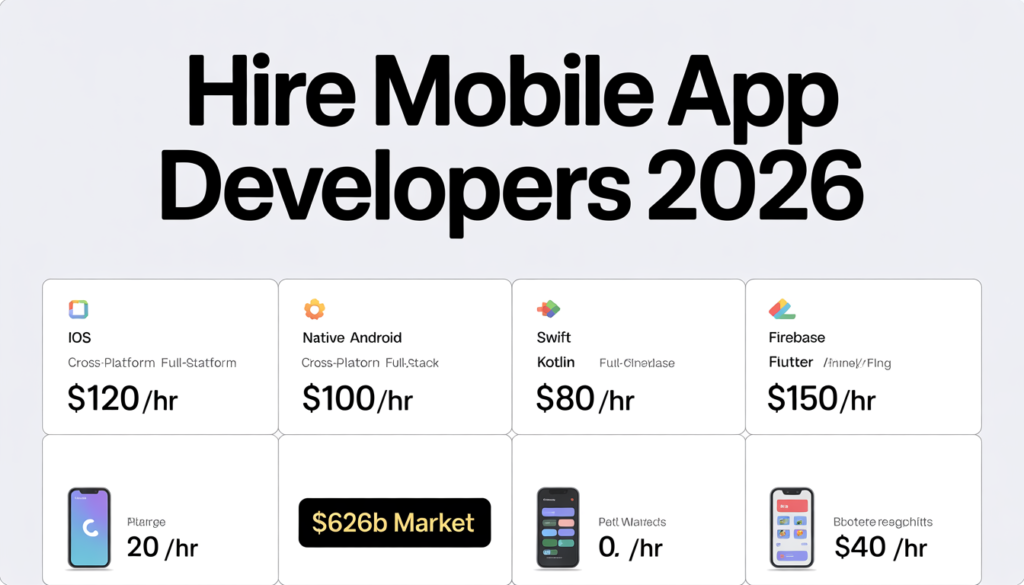
Before you post a job or contact an agency, this one decision determines everything else. Hiring the wrong type of developer, a cross-platform developer for an app that needs native performance, for example, leads to expensive rework down the line.
Native iOS Developer: When Does It Make Sense?
If your primary audience is on iPhone and your app demands the highest possible performance, think real-time video processing, AR features, or premium financial apps, a native iOS developer is your best option.
They work in Swift or SwiftUI and follow Apple’s Human Interface Guidelines closely. The tradeoff: you’ll need a separate Android developer to reach that market.
Native Android Developer, Who Should Choose This?
Android holds over 70% of global smartphone market share. If your target users are in emerging markets, or your product is enterprise-focused (many companies standardize on Android devices), a native Android developer, working in Kotlin or Java, is the right hire. Like native iOS, this approach delivers peak performance but requires a separate iOS developer for full coverage.
Cross-Platform Developer (Flutter / React Native), The Smart Default for Most Startups
For most startups and growth-stage companies, cross-platform development is the right starting point. One codebase runs on both iOS and Android, which cuts development time and cost significantly.
Flutter (Google) and React Native (Meta) are the two dominant frameworks. Flutter usage has grown to 46% of cross-platform developers globally as of 2024 (Stack Overflow Developer Survey), it is now the most popular choice for new projects.
Full-Stack Mobile Developer, When You Need Backend Too
If your app requires user accounts, real-time data, payment processing, or any server-side logic, you need a developer who can handle both the mobile frontend and the backend.
A full-stack mobile developer (Flutter + Node.js, React Native + Firebase, etc.) can own the entire technical stack. This is more expensive but eliminates the coordination cost of managing two separate developers.
Quick Reference: Which Developer Type to Hire
| App Goal | Platform | Recommended Developer | Framework |
| Max performance, premium UX | iOS only | Native iOS Developer | Swift / SwiftUI |
| Android-first market | Android only | Native Android Developer | Kotlin / Jetpack |
| Launch on both platforms fast | iOS + Android | Cross-Platform Developer | Flutter / React Native |
| App + backend + APIs | iOS + Android | Full-Stack Mobile Developer | Flutter + Node.js / Firebase |
Freelancer vs Agency vs Dedicated Team, Which One Is Right for You?
Every hiring model works in the right context. The question is which one aligns with your budget, timeline, and how much internal management capacity you have.
When Should You Hire a Freelance Mobile App Developer?
Freelancers are the right choice when your project is small, clearly scoped, and has a fixed deadline. They’re cost-effective and widely available on platforms like Upwork, Toptal, and Freelancer.
The downside is that you’re responsible for project management, QA coordination, and making sure handoffs don’t fall apart. Freelancers work best for MVPs, prototypes, or adding specific features to an existing app.
Important: A single freelancer rarely covers everything. You will likely need separate freelancers for QA, backend, and UI design, factor this into your true cost estimate.
When Does a Mobile App Development Agency Make Sense?
An agency provides an end-to-end team: developers, designers, QA specialists, and a project manager. You hand over a brief and receive a product.
This model makes sense when you lack internal technical leadership, need a turnkey solution, and have a larger budget. Agencies are listed and reviewed on Clutch and GoodFirms, always check verified client reviews before engaging.
What Is a Dedicated Development Team and Who Needs It?
A dedicated team is a group of developers employed by an external firm but working exclusively on your project, essentially your own engineering team without the hiring overhead.
This model offers the control of in-house development with the cost efficiency of outsourcing. It’s the best choice for long-term product builds where you need continuity, flexibility to scale, and close collaboration.
Nearshore vs Offshore, Cost Savings vs Real Risks
Nearshore teams (Latin America for US companies, Eastern Europe for European companies) offer similar time zones and cultural alignment with cost savings of 40 to 60% versus US rates.
Nearshore Latin America rates average $40 to 80/hr versus $100 to 180/hr in the US (Arc.dev, 2024). Offshore teams (South Asia, Southeast Asia) offer the deepest cost savings but come with real risks: timezone friction (10 to 12 hour difference), communication delays, IP protection concerns, and inconsistent quality control.
If you go offshore, you must have a clear NDA, milestone-based payment structure, and a strong internal point of contact managing the relationship daily.
| Model | Cost Range | Control | Best For | Risk Level |
| Freelancer | $15 to 100/hr | High | MVP, small scope | Medium |
| Agency | $50 to 200/hr | Medium | End-to-end project | Low |
| Dedicated Team | $2,000 to 8,000/mo | Very High | Long-term product | Low |
| In-House | $90,000 to 150,000/yr | Full | Core product team | Very Low |
How Much Does It Cost to Hire a Mobile App Developer in 2026?
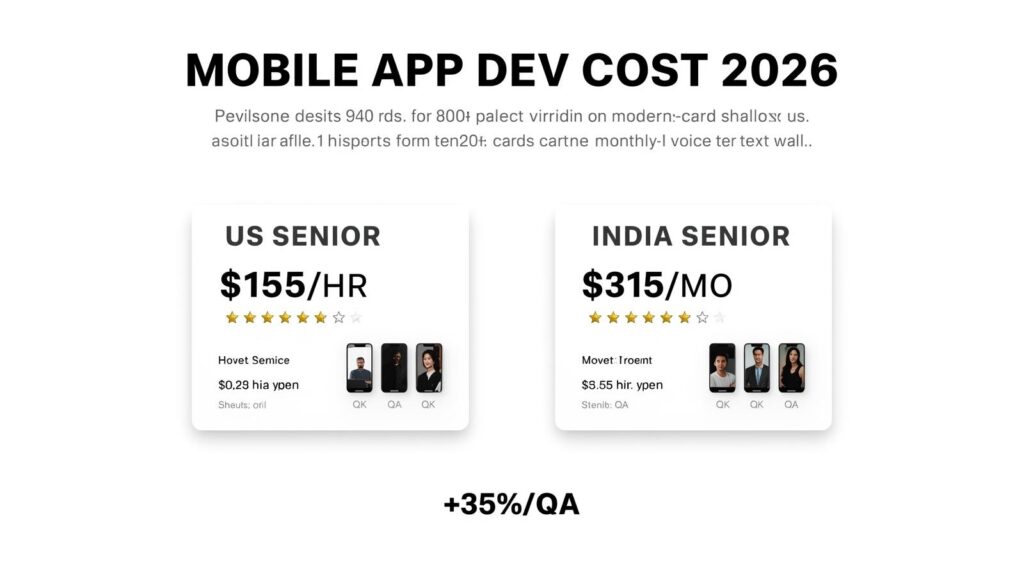
The cost figures most guides publish are either outdated or stripped of context. Here is what you actually need to budget for.
Hourly Rates by Region and Developer Level
Rates vary significantly by region, experience level, and hiring model. A senior mobile developer in the US commands $130 to 180/hr, while an equally skilled developer in South Asia may charge $40 to 70/hr.
The average in-house senior mobile developer salary in the US is approximately $128,000/year (Bureau of Labor Statistics, 2024).
| Region | Junior/hr | Mid/hr | Senior/hr | Dedicated/mo |
| United States | $60 to 80 | $90 to 130 | $130 to 180 | $8,000 to 15,000 |
| Eastern Europe | $25 to 40 | $40 to 65 | $65 to 100 | $4,000 to 7,000 |
| Latin America | $25 to 45 | $40 to 70 | $60 to 90 | $3,500 to 7,000 |
| South Asia (India) | $15 to 25 | $25 to 45 | $40 to 70 | $2,000 to 5,000 |
Hidden Costs Nobody Budgets For
The developer’s rate is only part of your true cost. Hidden costs can add 30 to 40% to your total project budget. Here is what most companies forget to plan for:
- QA and testing: Manual and automated testing adds 15 to 20% to development time
- Revision cycles: Expect 2 to 3 rounds of revisions per major feature
- Tool and license fees: Xcode, Android Studio, design tools, analytics platforms
- Post-launch maintenance: Bug fixes, OS updates, performance monitoring, budget 15 to 20% of build cost annually
- Project manager overhead: If the developer isn’t self-managing, you need one
- Timezone meeting costs: Offshore teams require structured sync time, factor this into your schedule
Where Can You Find Reliable Mobile App Developers?
Not all platforms attract the same quality of talent, and the right source depends entirely on what you need. Here is an honest breakdown of where to look and what to expect.
Upwork
Largest global freelance marketplace. Wide range of quality, you must vet heavily. Use the Enterprise tier for higher-quality matches. Best for flexible, shorter engagements.
Toptal
Accepts only the top 3% of applicants through a rigorous screening process. 2 to 3x the cost of Upwork, but significantly more reliable for mission-critical projects.
Clutch and GoodFirms
B2B directories with verified agency reviews. Best for finding a development agency. Filter by budget, tech stack, and industry experience. Always read 3+ detailed reviews.
Underused for developer sourcing. Effective for direct outreach to senior developers. Use filters for tech stack, location, and past companies.
Dedicated staffing platforms
For long-term dedicated teams, firms like Arc.dev, Lemon.io, and Andela provide pre-vetted global talent with structured onboarding.
| Platform | Best Use | Avg Cost | Vetting Level | Risk |
| Upwork | Flexibility, MVP | $15 to 80/hr | Low (self-vet) | Medium-High |
| Toptal | Mission-critical apps | $60 to 200/hr | Very High (top 3%) | Low |
| Clutch | Agency search | $50 to 200/hr | High (verified reviews) | Low |
| Direct senior hires | Negotiable | Medium | Low-Medium | |
| Dedicated Firms | Long- teams | $2k to 8k/mo | High | Low |
term
How Do You Vet a Mobile App Developer Before Hiring?
A polished portfolio and smooth interview do not confirm a good developer. Here is how to find out what you are actually getting before you sign anything.
What to Look for in a Mobile App Developer’s Portfolio
Ask for live app links, not just screenshots. Download the app, test it on a real device, and look for load speed, navigation quality, and crash behavior.
Ask for a GitHub profile or code repository. A developer with no public code or no ability to share a private sample is a significant warning sign.
5 Interview Questions That Reveal Real Skill
Generic interview questions tell you very little. Use these instead:
- How do you handle state management in a large-scale Flutter or React Native app? Walk me through your approach.
- Describe a time when your app was rejected from the App Store or Google Play. What was the reason and how did you resolve it?
- How do you approach performance optimization when an app is experiencing slow load times or memory issues?
- What is your process for securing user data in a mobile app, specifically around authentication and local storage?
- If a client changes a core feature requirement mid-project, how do you handle scope, timeline, and communication?
NDA, IP Ownership, and Contract Essentials
Before any code is written, ensure your contract explicitly states: (1) You own 100% of the IP and source code upon payment, (2) the developer signs an NDA covering your app concept, codebase, and business logic, (3) milestone-based payment structure with defined deliverables, and (4) a clear termination clause with code handover obligations. Do not proceed without these four elements in writing.
Vetting Checklist, Before You Sign
| Vetting Area | What to Check |
| Portfolio | Live apps, GitHub repos, code samples |
| Technical Skills | Ask platform-specific architecture questions |
| Communication | Response time, clarity, proactive updates |
| Code Quality | Request a short paid test task |
| Legal | NDA signed, IP ownership clause in contract |
| References | Speak to 1 to 2 past clients directly |
What Are the Red Flags When Hiring a Mobile App Developer?
These warning signs appear before the project starts, and most people ignore them because they are eager to get moving. According to the Standish Group Chaos Report, 37% of software projects fail due to poor vendor selection. Here is what to watch for.
Red Flags Before You Hire
- Portfolio with no live apps, only mockups or “in progress” projects
- Unable or unwilling to share code samples or a GitHub profile
- Quotes a price without asking detailed questions about your requirements
- Refuses to sign an NDA or claims IP ownership over work they produce for you
- No questions about your users, platform, or technical requirements during the first call
Red Flags Mid-Project, And When to Walk Away
- Goes silent for more than 48 hours without explanation
- Consistently misses milestones without proactive communication
- Delivers code that cannot be reviewed, tested, or understood by another developer
- Scope creep requests tied to cost increases that were never discussed upfront
- Refuses to add a second developer or reviewer to the project for quality checks
When Should You NOT Hire a Mobile App Developer Yet?
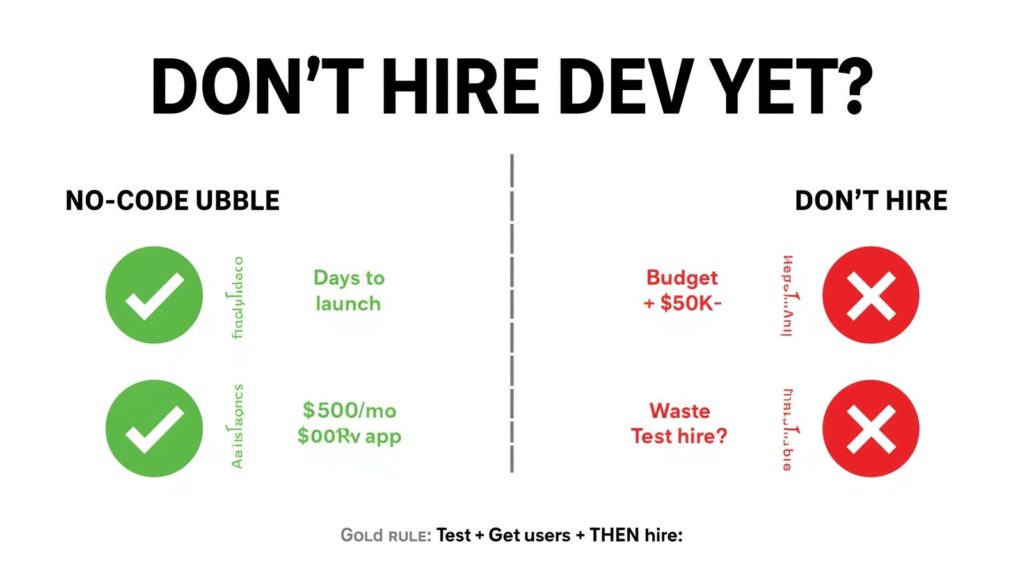
Hiring before you are ready is one of the most expensive mistakes in tech. Sometimes the right answer is to validate first and build later.
When No-Code or Low-Code Is the Better Option?
If you are testing a business idea and do not yet know if users will pay for it, consider no-code tools like Adalo, Bubble, or Glide before hiring a developer. These platforms can produce functional apps in days for a fraction of the cost. Once you have validated demand and have real users, you can invest in a custom build with confidence.
When Your Budget Is Not Ready for Quality?
A simple cross-platform MVP costs $15,000 to 40,000 from a quality developer or agency. If your budget is significantly below this and you cannot afford a dedicated team offshore, you are likely to get a product that costs more to fix than it would have cost to build correctly.
A better path: raise more budget, reduce scope to the absolute minimum viable feature set, or explore no-code alternatives. Cutting corners on development quality is almost always more expensive long-term.
How Do You Hire a Mobile App Developer, Step by Step?
Now that you understand the types, costs, and risks, here is the exact process to follow from day one.
Define your app scope and requirements
Document what the app does, who it is for, what platform it targets, and what the MVP feature set is. The more specific your brief, the more accurate and comparable your developer quotes will be.
Set a realistic budget based on real costs:
Use the cost table above to calculate a realistic range for your region and hiring model. Add 30 to 40% for hidden costs. Build a contingency of 15% for scope changes.
Choose your hiring model:
Based on your budget, timeline, and internal capacity, decide between freelancer, agency, or dedicated team. Use the comparison table above as your decision guide.
Shortlist and vet candidates:
Use the vetting checklist above. Request live app links, a code sample, and at least one client reference you can call directly. Run the five interview questions from this guide.
Structure the contract and kick off:
Confirm IP ownership, NDA, milestone payments, and communication expectations in writing before any work begins. Define your first milestone clearly, a working prototype or a specific screen, so you can evaluate quality early.
Final Thoughts
Hiring the right mobile app developer comes down to three decisions made in the right order: knowing what type of developer you need, choosing the hiring model that matches your budget and timeline, and vetting candidates with the rigor the decision deserves.
The companies that get this right do not necessarily have bigger budgets, they have a clearer process. Use the frameworks, tables, and checklists in this guide as your decision toolkit, and you will avoid the mistakes that derail most mobile app projects before they even launch.
Frequently Asked Questions
How much does it cost to hire a mobile app developer in the US?
Hiring a senior mobile app developer in the US costs $130 to 180/hr or approximately $128,000/year in-house. Offshore dedicated developers cost $2,000 to 6,000/month. A simple cross-platform MVP typically runs $15,000 to 50,000 total.
What is the difference between hiring a freelancer and a development agency?
A freelancer gives you direct access to one developer at lower cost but requires you to manage QA, design, and project management yourself. An agency provides a full team with processes in place but costs more and offers less flexibility in team selection.
How long does it take to hire a mobile app developer?
Through platforms like Upwork or Toptal, you can engage a developer within 3 to 7 days. Agencies typically have a 1 to 2 week discovery and proposal phase before work begins. Building a dedicated team can take 2 to 4 weeks.