Understanding the cost of Procore construction software before investing is crucial for contractors in the United States. Procore doesn’t list standard prices publicly, so it can feel confusing to budget for it.
In this guide, we’ll break down real cost ranges, hidden expenses, implementation fees, and practical budgeting tips for small, mid‑sized, and large construction firms.
Whether you’re comparing alternatives or planning your software spend, this article helps you make an informed decision.
What is Procore and Why Pricing Matters?
In this section, we explain what Procore is and why knowing its pricing structure matters for your business.
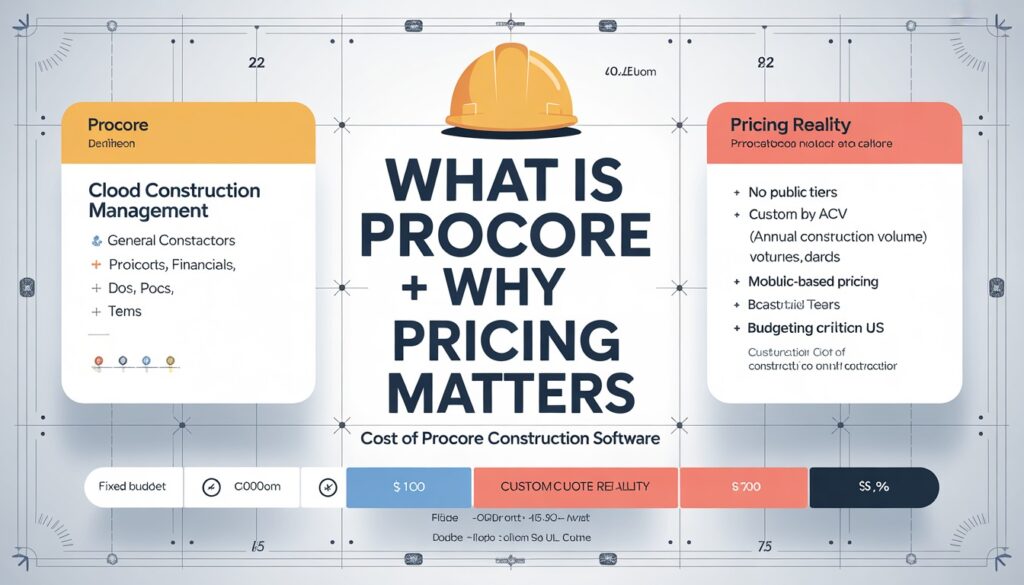
Procore is a leading cloud‑based construction management platform used by general contractors, specialty contractors, and owners to manage project workflows, financials, documentation, and team collaboration.
The pricing model is custom based on your Annual Construction Volume (ACV) and modules selected, not a public tiered list, which is why upfront budgeting is critical for contractors.
Procore Pricing Overview
This part gives a high‑level snapshot of how Procore’s pricing works before deeper cost breakdowns.
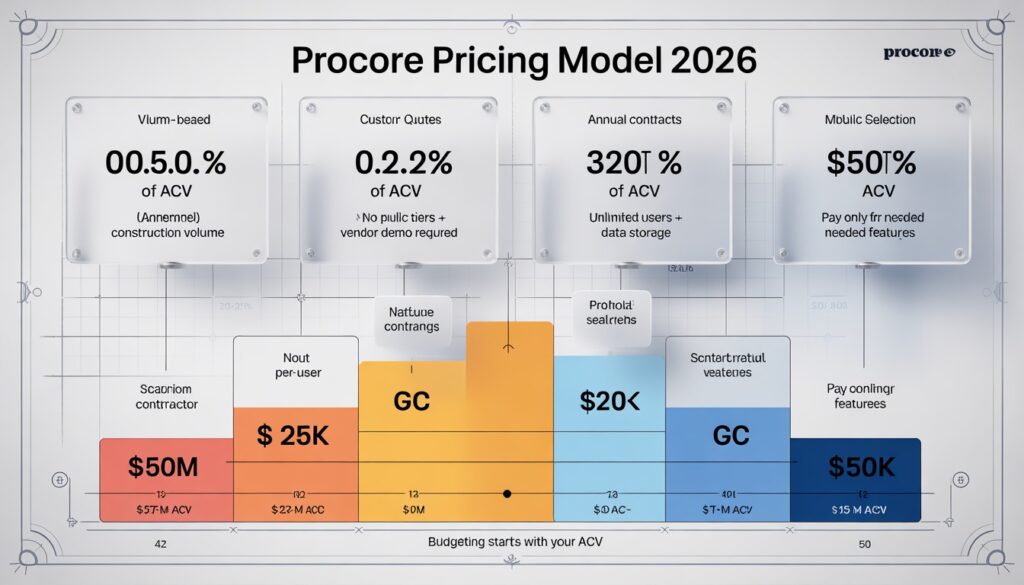
Procore uses a volume‑based pricing model tied to your annual construction volume rather than per‑user or fixed tier pricing. That means the cost often aligns with a percentage of your total project spend and the number of modules you need.
Procore contracts are typically annual and require custom quotes directly from the vendor. All plans include unlimited users and unlimited data storage.
How Much Procore Costs (Detailed Estimates)
Here we provide practical cost ranges from industry data and real use cases so you can actually budget for Procore.
For Smaller Contractors (ACV under $10M)
Smaller contractors often see lower entry costs but still pay a meaningful amount due to ACV‑based pricing.
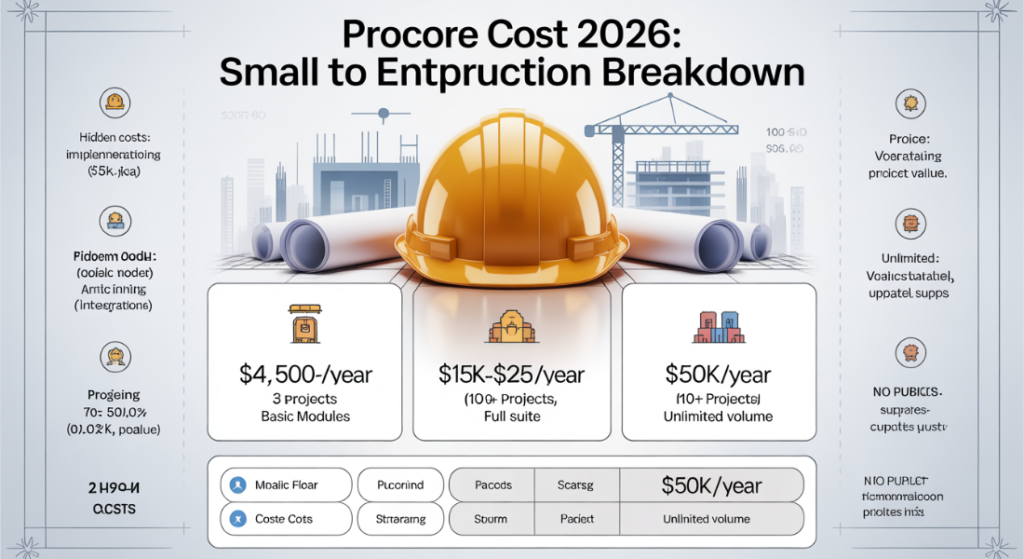
Annual subscription costs might be around $4,000 to $6,000 for basic project execution tools, with implementation adding $5,000‑$15,000.
For Mid‑Sized Contractors ($10M–$50M ACV)
Mid‑sized firms typically encounter first‑year costs in the range of $10,000 to $60,000+, which includes the annual plan plus onboarding and training.
Typical subscription segments fall around $375‑$975 per month per user before onboarding and integration costs.
For Large Contractors ($50M+ ACV)
Large contractors with high annual volumes may see total first‑year spending of $80,000–$200,000+, including advanced modules, integrations, and implementation.
Industry reports show base annual costs between $50,000‑$100,000 with onboarding, data migration, and integrations adding $55,000‑$115,000 extra.
Pricing Table Example (Estimated):
| Company Size | Base Annual Cost* | Implementation & Training | Data Migration & Integration | Estimated Total Year 1 |
| Small (<$10M) | $4,000–$6,000 | $5,000–$15,000 | $5,000–$10,000 | $14,000–$31,000 |
| Mid ($10M–$50M) | $10,000–$60,000+ | $12,000–$40,000 | $10,000–$30,000 | $32,000–$130,000+ |
| Large ($50M+) | $50,000–$100,000 | $25,000–$75,000 | $20,000–$100,000 | $95,000–$275,000+ |
Cost estimates based on industry reports and user feedback. Actual pricing varies by ACV and selected modules.
Factors Affecting Procore Cost
Here we explain what drives Procore’s pricing so you can understand which parts of your business influence how much you’ll pay.
There are several key elements that influence how Procore costs stack up:
- Annual Construction Volume (ACV): The core driver of pricing, higher ACV generally means higher subscription costs.
- Modules & Features: Project Management, Financials, Quality & Safety, and other add‑ons each contribute to total spend.
- Implementation & Onboarding: Professional services to set up Procore can add significant one‑time fees, especially for complex workflows.
- Integrations: Connecting Procore with accounting, scheduling, or reporting tools may incur extra costs.
- Training: Extended or customized training sessions may add to first‑year costs.
Implementation Costs and Tips
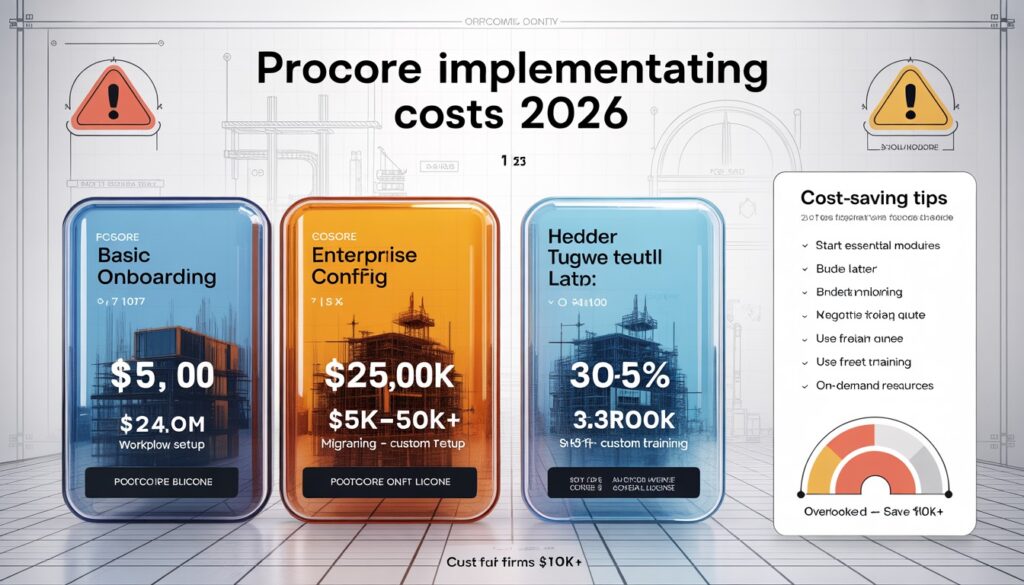
In this section, we break down typical onboarding and setup costs, often overlooked but significant.
Implementation costs for Procore can range from $5,000 for basic onboarding to $50,000+ for enterprise‑level configuration, involving workflow setup, data migration, and custom training.
Tips to Save on Implementation:
- Start with essential modules and scale up later.
- Request bundled onboarding packages when negotiating your quote.
- Use Procore’s on‑demand education resources where possible.
How to Negotiate the Best Procore Deal?
Here we give practical negotiation strategies contractors use to lower their effective costs. Procore pricing is negotiable, especially for longer contracts or larger ACV commitments. You can often:
- Ask for multi‑year discounts.
- Bundle required modules to reduce overall cost.
- Leverage competitor pricing as negotiation leverage.
- Request phased onboarding to spread initial costs.
Negotiation is particularly effective when you can demonstrate long‑term commitment or predictable annual volumes.
Procore ROI: Benefits You Can Expect
Price is only part of the equation, it’s also important to measure return on investment. Procore’s unified platform can improve collaboration, reduce delays, eliminate duplicate data entry, and centralize financial tracking.
Many mid‑sized contractors report significant workflow efficiencies and reduced rework after implementation.
One common measure of ROI is calculating time saved on project documentation and approvals versus labor cost, this often offsets part of the software fee over time.
Procore vs Alternatives (Pricing & Features)
This section compares Procore to other construction software options so you can weigh cost versus value.
| Software | Typical Pricing | Best For |
| Procore | Custom quote based on ACV * (no public price) | Large & complex projects |
| Buildertrend | ~$6,000–$12,000/year | Small & mid‑sized firms |
| Fieldwire | ~$50+/user/month | Field task management |
| Plans & Tools | varies | Smaller teams with specific use cases |
Procore excels with unlimited users and data, but smaller contractors often prefer alternative tools with transparent pricing and lower entry cost.
Final Thoughts
Understanding the cost of Procore construction software is essential for budgeting accurately and maximizing your ROI.
Whether you’re a small, mid-sized, or large contractor, considering modules, implementation, and hidden fees upfront can save thousands of dollars and streamline project management
FAQs
How much does Procore construction software cost per month?
Procore is usually billed annually, but monthly equivalents range $375 to $3,000 per user depending on company size, modules, and annual construction volume (ACV).
How much does Procore cost per year for US contractors?
Annual costs range from $10,000 to $60,000+ for small to mid-sized firms, with large, complex projects potentially exceeding $100,000 to $600,000, including implementation fees.
Can subcontractors use Procore for free?
No. Subcontractors may get access through general contractors on projects, but full standalone use requires a paid license.
What factors affect Procore pricing?
Costs depend on company size, ACV, selected modules, onboarding, integrations, and training, with multi-year contracts sometimes offering discounts.
How do I estimate total Procore cost for my firm?
Add annual subscription, onboarding, training, modules, integrations, and ACV adjustments to get the first-year total for budgeting purposes.
Are there hidden fees in Procore pricing?
Yes, implementation, training, premium support, and data migration can add significantly to the base software cost.