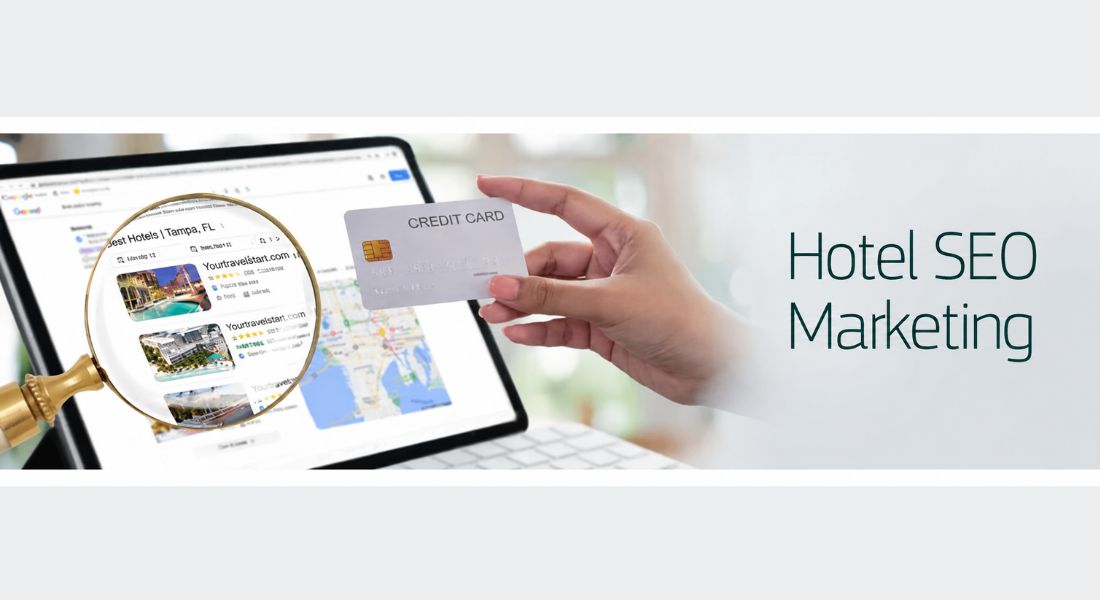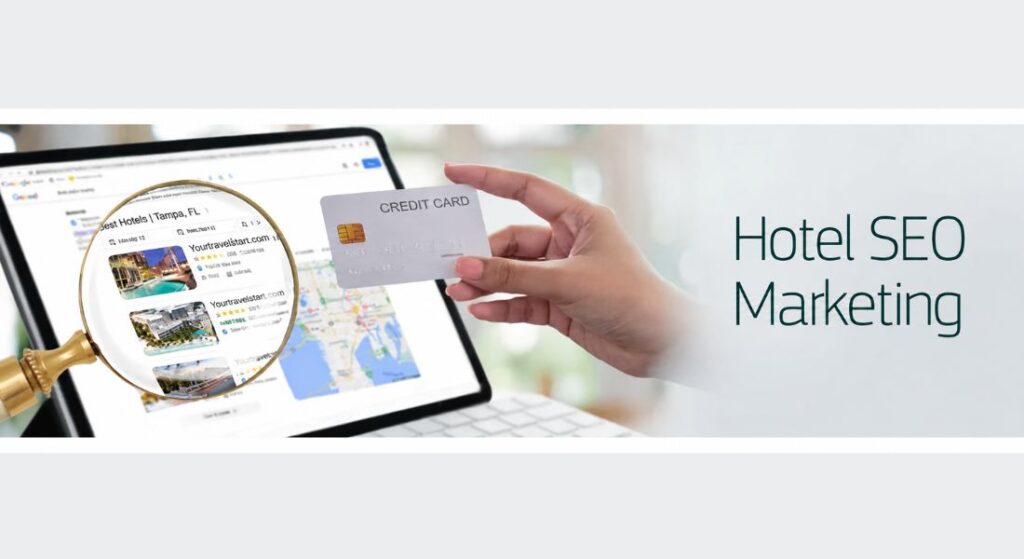
SEO for hotels is the process of optimizing your hotel’s online presence so travelers find your property on Google and book directly on your website, not through an OTA.
Every OTA booking costs you 15 to 25 percent in commission. Hotel SEO eliminates that cut by building a direct booking channel that grows stronger every month and costs you nothing per reservation.
In this guide, you will learn exactly how to optimize your Google Business Profile, target keywords real travelers use, build destination content, fix your technical foundation, and earn backlinks that push OTAs out of your rankings.
What Is SEO for Hotels and Why Direct Bookings Depend on It?
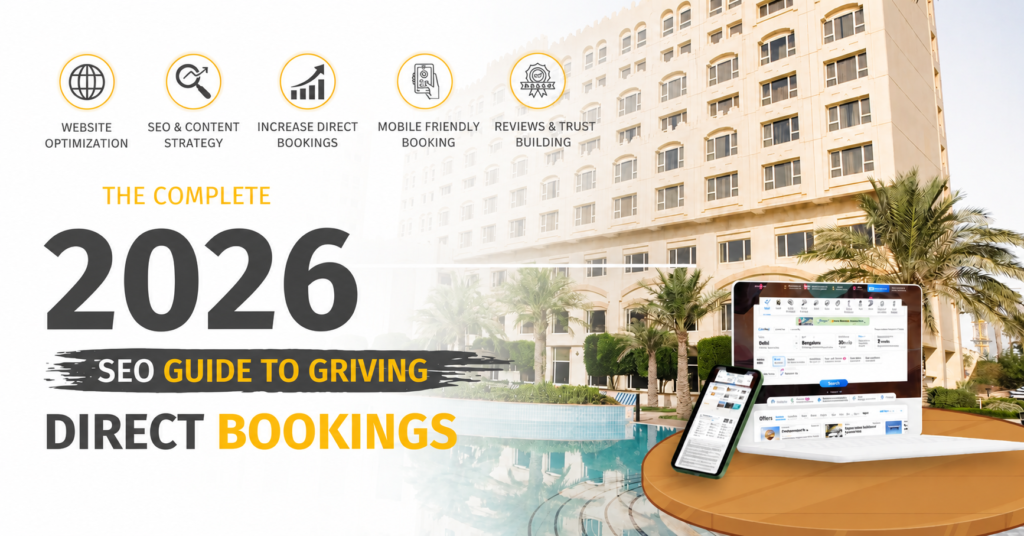
Hotel SEO drives commission-free direct bookings by making your property appear in Google search results before OTA listings reach the traveler.
It is about owning the moment a traveler decides where to stay. When your hotel appears organically in search results, that traveler lands on your website not an OTA listing and every booking they make costs you nothing beyond your marketing investment.
The hospitality industry operates in one of the most competitive local search environments online. OTAs invest millions in SEO annually. They rank for your hotel name, your city, your neighborhood, and every high-intent keyword a traveler might use to find you.
When an OTA listing appears above your own website in search results, you pay a commission to a platform that simply outranked you.
The Real Cost of Ignoring Hotel SEO
Every OTA booking directly reduces your RevPAR ‘Revenue Per Available Room’, which measures how much revenue each hotel room generates on average. Multiply a 20 percent commission across hundreds of bookings per year and the revenue loss becomes a significant business problem.
Hotel SEO solves this by building a direct booking channel that earns more with every optimization you add, compounding in value unlike paid ads that stop the moment your budget runs out.
| Factor | Hotel Direct SEO | OTA Listing |
| Commission per booking | 0% | 15–25% |
| Traffic ownership | Yours | OTA’s |
| Long-term value | Compounds monthly | Stops when you pay |
| Brand control | Full | Limited |
| Ranking control | Yes | No |
How Organic Visibility Builds Long-Term Revenue?
Hotels that invested in SEO two or three years ago now sit on top-ranking positions that generate direct bookings every month with minimal ongoing spend.
The initial optimization work becomes a durable revenue asset, one that no OTA can take away and that grows stronger as your domain authority, content depth, and local signals accumulate over time.
How Long Does Hotel SEO Take to Show Results?
Hotel SEO typically takes 3 to 6 months to show measurable ranking improvements. Google Business Profile optimizations and technical fixes show results faster often within 4 to 8 weeks while content and link building compound over 6 to 12 months into consistent direct booking growth. Properties that start now build an advantage that competitors who delay cannot easily recover.
Why Does Google Business Profile Control Your Local Search Visibility?
Your Google Business Profile is the single most powerful local SEO asset your hotel directly controls.
When travelers search for hotels in your area, Google displays a Local Pack, a map-based section featuring three prominently listed properties that appears before almost every organic result, capturing the highest click-through rate of any search feature on the page. Whether your hotel appears there depends entirely on how well your GBP is optimized.
The Local Pack surfaces your photos, star rating, amenities, address and a direct link to your website before a traveler visits any individual hotel page. Hoteliers who treat GBP as a secondary task are leaving their most impactful local SEO tool completely underused.
NAP Consistency and Citation Accuracy
NAP Name, Address, Phone Number must match exactly across every platform where your hotel appears: your website, GBP, TripAdvisor, OTA profiles, and local directories.
Even minor inconsistencies like writing “Street” on one platform and “St.” on another send conflicting signals that weaken your local authority and suppress your Local Pack ranking. Run a citation audit and fix every discrepancy you find.
Photos, Amenities and Review Management
Google confirms that GBP listings with more high-quality photos receive more website clicks and direction requests. Upload images of your rooms, lobby, pool, restaurant, and signature property features and refresh them regularly.
Fill every amenity field completely, because Google uses this data to match your listing to specific traveler searches like “hotel with EV charging near O’Hare Airport.”
Respond to every guest review, positive or negative. Active review management signals to Google that your listing is maintained, which improves local pack rankings. It also signals to prospective guests that your hotel cares about the guest experience, which directly influences booking decisions.
How Keyword Research Works Differently for Hotel Websites?
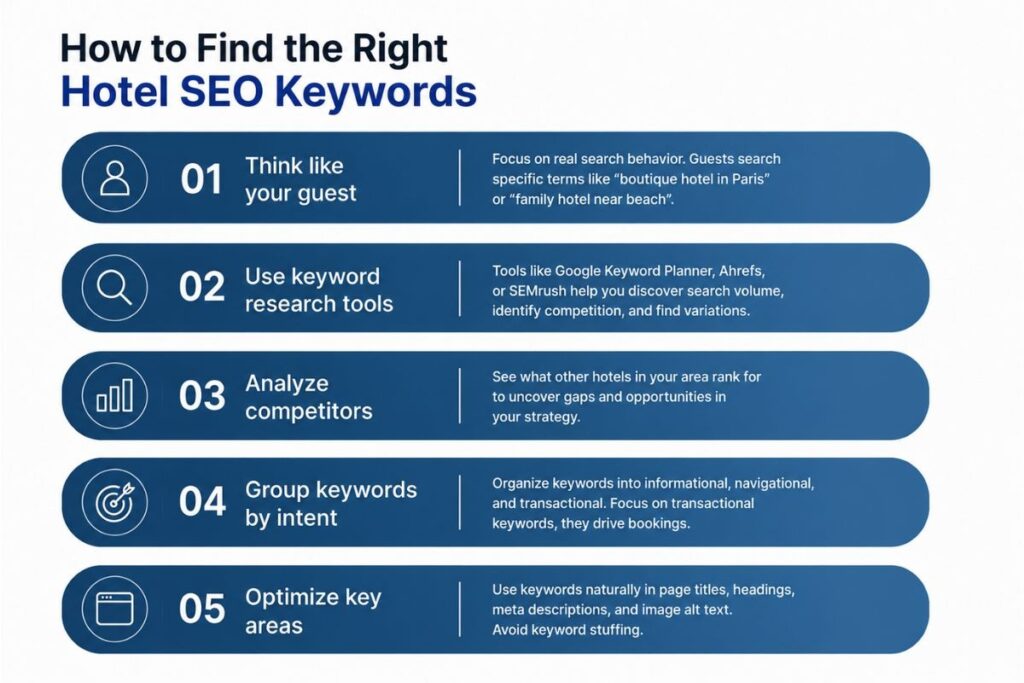
Most hotel websites target broad terms like “hotel in New York” and fail to rank because OTAs dominate those searches with decades of authority. The guests who actually book are searching with specific, intent-driven phrases and those are the keywords your hotel needs to own.
Hotel keyword research works in three layers. The first targets core property terms: your city, neighborhood, and property type. The second targets experience-driven phrases built around amenities and features searches like “pet-friendly resort near Yellowstone” or “hotel with rooftop bar in Nashville.”
The third targets destination informational queries, searches like “best things to do in Edinburgh” from travelers still in the planning phase who have not yet chosen a property.
Long-Tail Keywords With Real Booking Intent
A traveler searching “luxury boutique hotel in Savannah historic district with breakfast included” knows exactly what they want and is close to booking. Long-tail keywords like this have lower search volume but significantly higher conversion rates because the intent is already well-defined.
Use Google Search Console, Google Autocomplete, and the “People Also Ask” section in search results to discover how real travelers in your market phrase their searches; these organic signals are more accurate than any keyword tool alone.
Keyword Clusters for Guest Experience Pages
Build keyword clusters around specific guest experiences, honeymoon stays, corporate travel, family vacations, wedding accommodation and create dedicated landing pages for each.
A page targeting “wedding venue with hotel accommodation in Charleston” faces far less competition than a generic weddings page and attracts travelers with a clearly defined, high-value booking intent.
On-Page SEO That Converts Hotel Website Visitors Into Guests
On-page optimization makes every page on your website serve two audiences at once: search engine crawlers that need clear relevance signals, and real travelers who are evaluating your property and deciding whether to book. Every page must earn both the ranking and the click.
Your title tag is the most important on-page element. Your homepage title should clearly communicate your brand, property type, and location something like “The Grand Ashford | Boutique Hotel in Charleston, SC.”
Room pages should use descriptive, amenity-driven language like “Deluxe King Suite with Ocean View” rather than vague internal naming that tells neither Google nor your guest anything useful.
URL Structure and Meta Descriptions
Keep URLs clean, descriptive, and keyword-relevant. A URL like yourhotel.com/rooms/deluxe-king-suite tells both search engines and travelers exactly what the page contains before they click.
Meta descriptions do not directly affect rankings but they control click-through rate, write them to speak directly to traveler intent, include a distinctive property detail, and end with a clear call to action.
Dedicated Landing Pages for Rooms and Packages
Create individually optimized pages for each room category, seasonal package, and key property feature. A dedicated “Honeymoon Suite” page, a “Corporate Meeting Rooms” page, or a “Spa and Wellness” page can each rank independently for travelers searching those specific experiences. Each page multiplies your organic entry points and captures guest segments that a single homepage cannot reach.
Destination Content Strategy That Captures Travelers Before They Book
Travelers spend weeks researching a destination before they ever search for a specific hotel and your hotel website can appear in that research phase through destination content. They read restaurant guides, attraction lists, event calendars, and travel tips.
If your hotel website answers those questions with genuine, location-specific expertise, you appear in their journey early and stay top of mind when they reach the booking stage.
A destination blog lets you target informational queries that attract qualified visitors at the top of the travel funnel. A beach resort can rank for “best snorkeling near Phuket.” A city hotel can have its own “Edinburgh Fringe Festival guide.”
These articles bring travelers who are actively planning a trip to your location the exact audience that will need a hotel when they are ready to commit.
Every destination article should connect naturally back to your booking funnel through internal links to relevant room pages, packages, or an availability check prompt.
Destination content is not just a traffic strategy it is a direct booking conversion pathway when built with deliberate structure and genuine traveler utility.
Technical SEO Foundations Every Hotel Website Needs
Technical SEO is the infrastructure that allows all your other optimization work to perform at full potential. Great content and precise keyword targeting will underperform if your pages load slowly, break on mobile, or have crawl errors that prevent proper indexing.
Page speed is a confirmed Google ranking factor and hotel websites are particularly vulnerable because they are image-heavy by nature.
Compress every image before uploading, use a Content Delivery Network to serve assets quickly across geographic locations and eliminate unnecessary JavaScript that delays page rendering.
Google uses mobile-first indexing, meaning it ranks the mobile version of your site and with over 60 percent of hotel searches now happening on mobile devices, a slow or broken mobile experience costs you both rankings and bookings.
Schema Markup and Core Web Vitals for Hotels
Implementing LodgingBusiness schema, HotelRoom schema, and Review schema tells Google exactly what your business is and what each page contains. This enables rich results, star ratings, price ranges, and room details to appear directly in search results before a traveler clicks your listing, improving both click-through rate and booking conversion quality.
Core Web Vitals Google’s page experience signals covering load speed, interactivity, and visual stability are direct ranking factors. Use Google Search Console’s Core Web Vitals report to identify underperforming pages and prioritize fixes by traffic impact.
Link Building and Off-Page Authority for Hotel Websites
Backlinks from authoritative, topically relevant websites are among Google’s strongest ranking signals and hotels have more natural link-building opportunities than most industries. The most effective strategy combines local authority with editorial credibility.
Start with your city’s tourism board or Destination Marketing Organization (DMO). A link from their official accommodation listings is high-authority, contextually relevant, and signals directly to Google that your property is a recognized part of the local hospitality ecosystem.
Partner with local restaurants, event venues, and activity providers for mutual referral links. Sponsor local events and secure a mention on the event website. Travel blogger and journalist outreach earns the most valuable editorial backlinks.
Offer hosted stays to writers who regularly cover your destination. A single article on a high-traffic travel blog can send qualified visitors to your website for years and permanently strengthen your domain authority in ways that no directory listing can replicate.
Conclusion
Hotel SEO in 2026 rewards properties that execute consistently, not those that chase quick fixes. Optimize your Google Business Profile, target long-tail keywords with real booking intent, build destination content that serves travelers before they reach the booking stage, ensure your website is technically sound and mobile-fast and earn authoritative local backlinks.
Each of these efforts compounds on the others, creating organic visibility that reduces OTA dependency and grows your direct booking revenue month after month. Start now, execute consistently, and your rankings will reflect exactly how seriously you committed to it.
FAQs
Should a hotel invest in SEO or paid ads first?
SEO builds lasting commission-free traffic over time, making it the higher-return long-term investment compared to paid ads that stop delivering the moment spending stops.
How long does hotel SEO take to show results?
Hotel SEO typically takes 3 to 6 months to show measurable ranking improvements. Google Business Profile and technical fixes often show results within 4 to 8 weeks, while content and link building compound into consistent direct booking growth over 6 to 12 months.
How often should a hotel update its Google Business Profile?
Update your GBP at least once a month with new photos, posts, or amenity changes to maintain active management signals in Google’s local ranking algorithm.
What is the difference between hotel SEO and OTA optimization?
Hotel SEO drives organic traffic directly to your own website for commission-free bookings, while OTA optimization improves visibility within third-party platforms that charge 15 to 25 percent per reservation.
How do star ratings appear in Google search results for hotels?
Through Review schema markup, Google pulls your rating data and displays star ratings and review counts directly in organic search results as rich snippets before a traveler clicks.
Can a hotel rank well on Google without a blog or content section?
A hotel can rank for branded and location terms without a blog, but capturing travelers during the planning phase requires destination content that targets informational search queries OTAs and travel blogs currently dominate.