Ask a pathologist who has been practicing for twenty years what the hardest part of the job is, and you will probably get a thoughtful pause before the answer. It is not reading the slides. Most experienced pathologists will tell you they love diagnostic work.
What wears people down is the surrounding burden: the volume, the pressure to turn cases around quickly, the administrative layers, the fear of missing something subtle on case number forty seven of the day when mental fatigue is real.
Those pressures are what artificial intelligence, applied thoughtfully has a genuine shot at addressing. The use of AI in pathology labs has moved past the proof of concept stage. There are now FDA cleared algorithms designed to assist with specific diagnostic tasks including prostate cancer grading, mitosis detection in breast cancer and analysis of cervical cytology.
The clinical literature on their performance is growing, and what is emerging is a nuanced picture. AI does not outperform expert pathologists in most settings, but it performs very well in specific, constrained tasks and perhaps more importantly, it performs consistently.
Where AI Adds the Most Reliable Value?
It does not have better days and worse days. It does not get tired. It processes every image at the same level of attention, which makes it particularly valuable as a safety net for high volume, repetitive analysis tasks. The areas where AI assistance has shown the clearest practical value so far include:
- Triage and case prioritization, surfacing likely malignancies for earlier pathologist attention
- Mitotic figure counting which requires consistent attention across large tissue areas
- Biomarker quantification such as the percentage of cells staining positively
- Margin assessment for surgical specimens
- Pre-screening cytology slides to separate normal from abnormal cases
Accuracy Benefits: An Honest Assessment!
The accuracy benefits of AI are real, but they require some unpacking. AI does not eliminate diagnostic errors, and there are documented cases of AI systems failing in ways that can be difficult to predict.
An algorithm trained on slides from one population or one type of scanner may not perform as well on images from a different patient population or a different digitization platform. Bias in training data is a serious concern.
Lab professionals who work with AI tools emphasize that human oversight remains essential. These are decision-support tools, not autonomous diagnostic systems and the pathologist remains responsible for every report that goes out.
Where AI tends to improve accuracy in practical settings is in the mundane but critical tasks that do not require complex judgment but do require consistent attention.
Errors in quantitative assessments have real clinical consequences, and AI assistance on these kinds of tasks is where the technology currently adds the most reliable value.
Integration with LIS Platforms: Why It Matters?
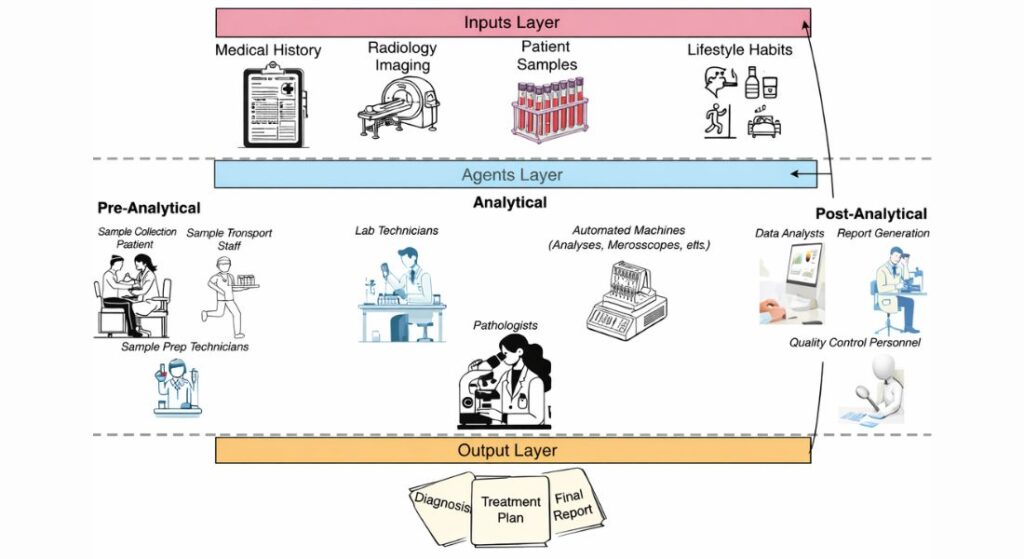
The integration of AI tools with laboratory information systems is where things get particularly interesting from an operational standpoint. An AI tool that operates in isolation, processing images and generating results that a pathologist then has to manually reconcile with the rest of the case record adds value but also adds friction.
The more compelling scenario is when AI analysis is embedded directly into the LIS workflow, so that image analysis results, AI flags, and pathologist review happen within a unified system.
NovoPath, operating in the anatomic pathology LIS space, has been developing integration capabilities that allow AI-assisted tools to connect into its platform workflow. The practical effect is that labs using the system can incorporate AI analysis without running a separate parallel workflow.
This matters because one of the documented challenges with AI adoption in clinical settings is that tools which create additional steps or interfaces often get used inconsistently or abandoned entirely.
Efficiency Gains: Where They Actually Show Up?
Efficiency gains from AI in pathology labs are real but often show up in unexpected places. Labs frequently report that the most immediate benefit is not faster diagnosis but rather administrative time returned to the pathologist. Some of the ways efficiency accumulates include:
- AI-assisted quantitative tasks return time for interpretive work that requires pathologist judgment
- AI-generated structured data from image analysis speeds up report completion
- Intelligent triage reduces time managing chaotic queues by routing the right cases first
- Consistent pre screening reduces the number of normal slides requiring full pathologist review
The Workforce Dimension
There is a workforce dimension to this conversation that does not get enough attention. Pathology is facing a shortage. The number of practicing pathologists has been declining relative to demand for services, a trend driven by retirement demographics, the complexity of subspecialization and growth in demand from oncology and molecular testing. AI assistance is not going to solve a workforce shortage, but it can help existing pathologists handle more cases without sacrificing quality.
What Successful AI Integration Looks Like?
The labs that are integrating AI most successfully share a few characteristics worth noting. First, they have invested in the digital infrastructure, including high quality whole slide imaging, compatible LIS platforms, and reliable connectivity, that AI tools require to function properly.
Second, they have approached AI as a tool that pathologists work with rather than something imposed on them. Third and critically, they have built validation processes to monitor whether AI tools are performing as expected in their specific patient population and case mix rather than assuming that published performance data will translate directly to their setting.
The trajectory of AI in pathology over the next decade will involve more capable models, broader application areas, and better standardization around validation and performance monitoring.
Labs that are building experience with AI tools now and developing the internal expertise to evaluate and monitor them, are better positioned to navigate that evolving landscape than labs waiting on the sidelines.